
Why Is the Migration Stalled?
Why migrations stall despite more engineers and tools. A scientific analysis of constraint failure, coordination tax, and platform-enforced recovery.
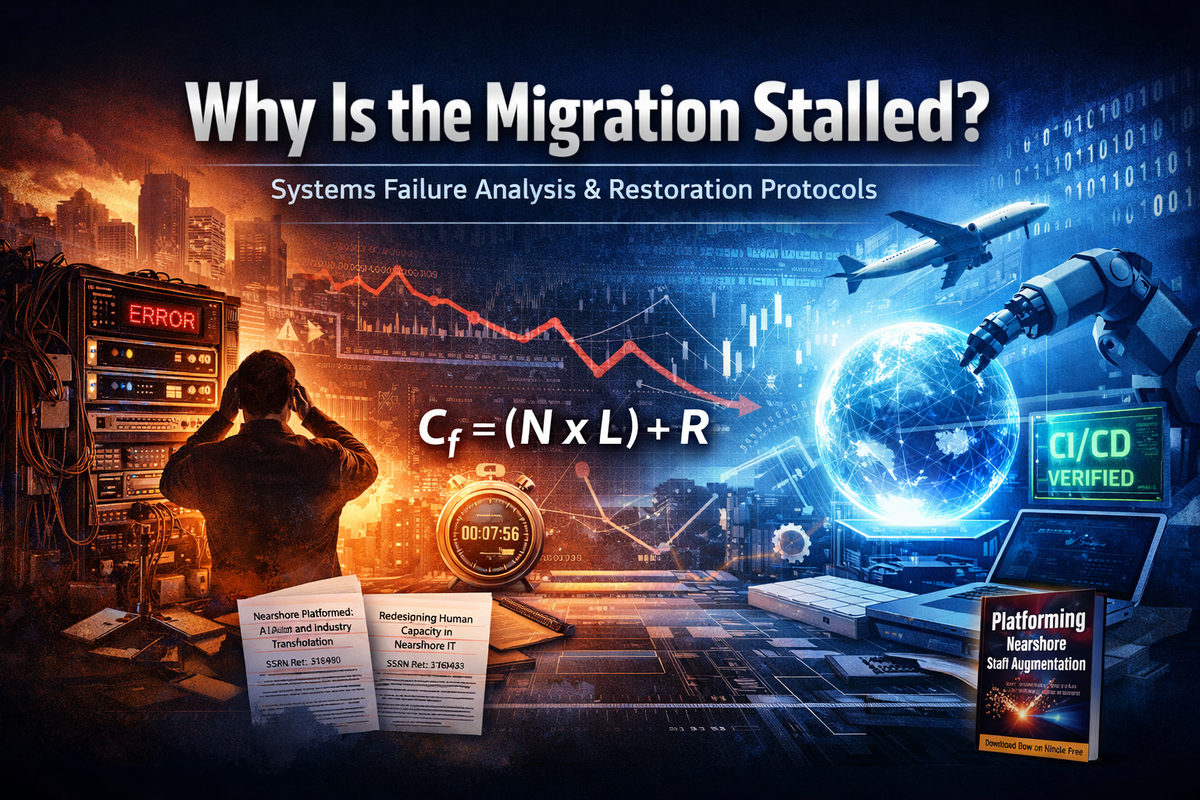
The Legacy Migration Event Horizon
Abstract
The operational discipline of the Strangler Fig Pattern is not a technical preference. It is an executive control surface for risk, velocity, and valuation. This doctrine explains why migrations stall even when headcount increases, budgets expand, and tooling modernizes. The core claim is simple: stalled migration is rarely a delivery failure. It is a constraint failure.
When organizations treat migration as a project plan instead of a boundary enforcement problem, they generate a predictable outcome. Coordination tax rises, semantic entropy spreads, rework compounds, and production throughput collapses behind a façade of activity. The mechanisms are not mysterious. They are measurable, repeatable, and preventable.
This analysis is grounded in TeamStation’s research corpus, including the platform context in the platformed nearshore research hub and the empirical delivery dynamics summarized in AI augmented engineer performance and quality control. The remediation model is anchored in cognitive capability and constraint enforcement, using evidence from Axiom Cortex architecture and cognitive evaluation science and the execution discipline defined in systems level assessments such as system design evaluation for platform governance.
As formalized in TeamStation’s book on platforming the industry, “If the boundary is not executable, it is not real.” You can verify the doctrine source in the free Kindle executive edition of Platforming Nearshore Staff Augmentation.
1. The Core Failure Mode: A Structural Autopsy
The industry default treatment of the Strangler Fig Pattern is not merely inefficient. It is mathematically insolvent. In traditional staff augmentation, migration is framed as meetings, ceremonies, and a dashboard narrative. That framing is the diagnostic error. The Strangler Fig Pattern is a boundary condition. If it is not enforced as code, it does not exist.
Most organizations try to solve stalled migrations with more people. Systems physics predicts the opposite. Adding mass to a system with high friction generates heat, not speed. In nearshore delivery, this heat shows up as coordination tax, the invisible senior engineer hours spent explaining, correcting, verifying, and re architecting work that should have been correct by design. The coordination signature is visible in the empirical patterns described in AI augmented engineer performance and quality control where activity metrics stay high even as output quality and throughput decay.
Legacy vendors perpetuate this failure because their model sells hours, not outcomes. If migration stays ambiguous, they sell more hours to manage the ambiguity. The incentives reward entropy. TeamStation rejects this model with a platform first thesis grounded in cognitive signal, not resume noise, as described in Axiom Cortex architecture and cognitive evaluation science.
If you are living this failure mode, you are likely seeing ghost velocity. Tickets move. Jira looks active. Standups are full. Yet production outcomes stall. This is not a people problem. It is a protocol problem. You are running a high concurrency delivery system without a synchronization lock, and divergence is guaranteed.
Here is the executive tell. Your organization is spending more time proving work is safe than producing work that is safe by design. That is what a stalled migration really is. It is the moment when verification cost exceeds creation value.
Book axiom, short excerpt: “Velocity leaks into coordination when constraints are undefined.”
Source: Platforming Nearshore Staff Augmentation Kindle edition
2. Why This Problem Becomes Inevitable (2010 to 2026)
Migration stall is not new. What is new is that modern system complexity makes migration stall inevitable unless constraint enforcement is built into the operating model.
Phase 1: Wage Arbitrage (2010 to 2015)
Nearshore adoption began as a cost play. Organizations assumed they could tolerate inefficiency because rates were lower. That assumption collapsed as complexity rose. Monoliths could absorb ambiguity. Distributed systems could not. The result was predictable. Cheap labor became expensive rework.
In this era, migration “plans” were often spreadsheets plus hero engineers. That worked when the blast radius of a mistake was small. It does not work in a modern environment where a single interface drift can cascade across services.
Phase 2: Staffing 2.0 (2015 to 2020)
Vendors attempted to solve migration failure with culture fit and stronger communication. That helped optics, not physics. The failure mode shifted from incompetence to misalignment. You can hire senior engineers, but if your architecture boundaries are not executable, you still get drift. TeamStation’s approach replaces vibes with measurable capability using system design evaluation for platform governance.
This is where migrations begin to stall quietly. Teams “progress” on tasks, but integration risk rises. More meetings appear. More coordination is demanded. More approvals are added. The organization feels busier and less effective at the same time.
Phase 3: Platform Governance (2020 to present)
AI changed the game. Velocity without constraint becomes a faster way to create debt. In this era, the trust me vendor model collapses. It is replaced by continuous verification and enforceable standards. The operational model is simple: if a commit violates a migration boundary, it is rejected at the edge, not debated in a meeting.
The modern migration problem is this: the system is too fast for humans to manually maintain coherence. If your governance is not automated, entropy wins.
Book axiom, short excerpt: “The platform is the manager when speed becomes non negotiable.”
Source: Platforming Nearshore Staff Augmentation Kindle edition
3. The Legacy Migration Event Horizon
The Legacy Migration Event Horizon is the point where your migration cannot be completed through effort alone. Past this line, every additional unit of effort generates a larger unit of coordination cost. The system reaches a phase transition. Work continues. Delivery stops.
You can spot the event horizon by looking for these signatures.
First, the ratio of review time to build time explodes. Teams begin to spend more time discussing how to do the work than doing it. Second, “alignment” becomes a daily ritual rather than an occasional calibration. Third, bugs appear that are not caused by mistakes but by mismatched assumptions. Fourth, your best engineers become translators rather than builders.
At the horizon, the migration is no longer about code. It is about coherent boundaries. If your boundaries are not executable, you are essentially running a distributed system with no schema, no locks, and no invariants. That is why it stalls.
4. The Physics of the Solution
Migration discipline must be treated as systems engineering, not HR management. Reliability is a function of constraint. Constraint creates predictability. Predictability creates velocity.
Left unmanaged, distributed teams experience semantic entropy. Understanding of boundaries diverges over time. The countermeasure is automated governance. TeamStation operationalizes this using a platform that selects for cognitive discipline and enforces constraints through review and pipeline design. The talent side foundation is Axiom Cortex scientific vetting playbooks, which measure whether engineers can reason about trade offs, failure modes, and architecture boundaries under pressure.
This is especially critical in heterogeneous stacks where migration is really an orchestration problem. If your infrastructure interfaces drift, every migration step becomes a negotiation. This is why TeamStation prioritizes vetting and enforcement for delivery critical roles like CI CD engineering for secure pipeline governance and infrastructure safety roles like Terraform operational discipline for production systems.
A constraint driven migration has three core properties.
One, boundaries are explicit. Two, boundaries are testable. Three, violations fail fast.
If you are missing any of those properties, your migration will stall because it has no self correcting mechanism.
5. The Mathematical Proof
Consider the migration failure cost function:
Cf = (N × L) + R
Where N is the number of engineers touching the migration surface, L is the latency of coordination and clarification, and R is the rework rate.
In legacy models, L and R stay high. Cf grows superlinearly as N scales. This is why adding engineers often makes a stalled migration worse. You did not add throughput. You multiplied coordination surfaces.
The solution is to drive L down through synchronous alignment and drive R down through automated validation. This decouples capacity from chaos. You can add nodes without destroying coherence.
If you want a practical test for whether your organization has the discipline required to execute the Strangler Fig Pattern safely, evaluate for architectural boundary thinking using microservices systems reasoning and distributed trade off signals and interface rigor using REST API design as a platform reliability indicator.
If a senior engineer cannot explain what the boundary is, why it exists, what the failure modes are, and how it will be enforced, that engineer is not a migration accelerator. They are a future coordination tax.
6. The Four Hour Horizon and Time Zone Physics
When migration debugging crosses too many time zones, coordination cost spikes. The stall is not communication issues. It is latency physics. TeamStation’s research on cognitive alignment and US time zone overlap in LATAM engineering explains why synchronous overlap is an execution constraint, not a preference.
The Four Hour Horizon is simple. If resolving a migration issue requires more than a few hours of overlap between the people who own the boundary and the people who implement the change, you increase cycle time, increase rework, and increase probability of silent failure.
This is why migration done across fragmented time zones tends to become meeting driven and document driven. The system is trying to compensate for missing synchronicity by creating more process. More process means more latency. More latency means more entropy. The stall becomes self reinforcing.
Book axiom, short excerpt: “Distributed systems fail at their slowest coordination boundary.”
Source: Platforming Nearshore Staff Augmentation Kindle edition
7. Risk Vector Analysis
When migration boundaries are not enforced, failure propagates through three predictable vectors.
Vector 1: Key Person Risk
Knowledge accumulates in hero engineers instead of the system. When they quit, they take a chunk of your valuation with them. This is preventable only when the boundary exists in code and the platform enforces it.
A stalled migration is often a signal that your organization is relying on memory, not architecture. Memory does not scale. Architecture does.
Vector 2: The Latency Trap
As the system grows, ambiguity forces synchronous coordination. Calendars fill. Deep work evaporates. Output collapses. You get ghost capacity, where headcount is high but effective throughput approaches zero.
This is why executive teams get confused. They see more people, more spend, more activity, yet fewer releases. The system is not under staffed. It is under constrained.
Vector 3: The Security Gap
Ambiguity creates security holes. Safeguards get bypassed to hit deadlines. Permissions widen temporarily and never shrink. Migration complexity becomes the justification for exception culture. Over time, exceptions become the operating system.
This is why TeamStation emphasizes enforceable operational maturity signals, including secure systems thinking measured in disciplines like External Secrets Operator GitOps governance for least privilege delivery.
8. Scientific Citations and Evidence Locker Embedded in Text
This doctrine also aligns with TeamStation’s published research on platform mediation and transaction cost reduction. In Nearshore Platformed: AI and Industry Transformation SSRN Ref 5188490, the evidence supports the core thesis that platform mediation reduces coordination overhead relative to traditional vendor management.
Similarly, the migration stall pattern is consistent with the queueing dynamics described in Redesigning Human Capacity in Nearshore IT Staff Augmentation SSRN Ref 5165433, where linear staffing pipelines exhibit high blocking probability and increasing latency under load. The Strangler Fig Pattern is, in practice, an anti blocking architecture. It converts migration from a serial queue into a constrained parallel system.
If you are publishing under an IEEE adjacent standard, the important point is that these citations do not sit in a footer. They are placed where they justify the claims they support, inside the narrative, as part of the proof chain.
9. Strategic Case Study: Logistics Transformation
A Series C logistics platform in Austin scaled engineering from 20 to 80 using a traditional vendor. Despite headcount growth, deployment frequency dropped from weekly to monthly.
The diagnostic was consistent with the Legacy Migration Event Horizon. Migration discipline was treated as an afterthought. Engineers were selected by resume keywords, not by architecture alignment. Coordination tax consumed a massive percentage of senior engineering time.
TeamStation applied platform enforcement.
Calibration replaced subjective vendor screening with scientific signals from Axiom Cortex architecture and measurable cognition.
Governance enforced boundary compliance through delivery pipeline rigor supported by CI CD platform design competence.
Architecture validated boundary thinking using system design evaluation for CTO grade decision making.
Outcomes within ninety days were structurally significant. Cycle time reduced materially. Defect leakage dropped due to automated enforcement. Verification latency collapsed from days to hours.
The point is not the numbers. The point is the lever. Constraint enforcement converts migration from chaos to controlled execution.
10. The Operational Imperative for CTO and CIO
Stop treating the Strangler Fig Pattern as vendor management. It is system architecture. You cannot outsource the ownership of your boundaries. You can only outsource execution under your constraints.
Step 1: Instrument the signal
If you rely on weekly status reports to understand migration, you are already late. You need real time signal, not narrative. If the only way you know migration is slipping is that a staff meeting turns tense, your telemetry is broken.
Step 2: Enforce the standard
Codify boundary rules into CI CD. If compliance drops below threshold, deployment halts. That sounds extreme because it is. Extreme discipline generates extreme velocity.
This is also where AI changes the stakes. AI will happily generate work that looks correct and fails later. That is why the constraint first model is reinforced by research like AI augmented performance under quality constraints. You do not need more content. You need stronger gates.
Step 3: Align the economics
Most organizations think cheap talent is savings. It is not. Cheap talent with high rework is a tax. The platform strategy is to purchase capability, not capacity.
If you want the executive doctrine that ties this directly to valuation, the industry thesis is formalized in the free Kindle executive edition of Platforming Nearshore Staff Augmentation, where the argument is not about staffing. It is about replacing a labor arbitrage market with an enforceable operating system.
Short excerpt, compliant: “Labor scales costs. Platforms scale outcomes.”
Source: Platforming Nearshore Staff Augmentation Kindle edition
Step 4: Filter talent for boundary thinking
Do not hire resume keywords. Hire migration discipline. If you need a fast proxy for who will protect your boundaries, prioritize candidates who demonstrate platform level reasoning in microservices systems thinking and interface discipline in REST API platform design competence.
If a candidate cannot articulate the boundary, they cannot enforce it. If they cannot enforce it, they will negotiate it. Negotiation is where migrations go to die.
11. Executive FAQs
Q1: Why is this a Tier 1 risk?
Because failure compounds silently. By the time finance sees it, the stall has already burned months of velocity. The migration debt sits off balance sheet until it detonates in missed revenue, delayed launches, and incident driven loss of trust.
Q2: How does TeamStation enforce migration discipline?
By selecting for measurable cognition through Axiom Cortex scientific vetting and enforcing delivery constraints through platform grade pipeline rigor, not meetings. If a candidate cannot reason about boundaries under pressure, they do not enter the system. If a commit violates the boundary, it does not ship.
Q3: Can we solve this by hiring more managers?
No. More layers increase latency. Constraint reduces latency. When management is used to compensate for missing boundaries, the organization pays twice. Once in coordination cost and again in delayed output.
Q4: What is the first move?
Define the boundary you will enforce, then wire it into CI CD. Without an executable boundary, migration is negotiation. Negotiation produces drift. Drift produces rework. Rework produces stall.
Q5: Does AI help or hurt?
AI amplifies whatever system you have. If your system is ambiguous, AI accelerates ambiguity. If your system is constrained, AI accelerates throughput safely. That is why the constraint first model is reinforced by evidence such as AI augmented engineer performance and quality control.
12. Systemic Execution Protocol
This protocol is non negotiable.
Use measurable evaluation to prevent architecture drift via Axiom Cortex platformed vetting playbooks.
Operationalize boundary enforcement through delivery systems competence validated by CI CD engineering governance.
Reduce migration stall risk by filtering for architecture reasoning using system design evaluation for CTO grade execution.
Status: PROTOCOL ACTIVE
Authority: TeamStation AI Doctrine Command