
Why is integration hell?
A scientific doctrine for CTOs and CIOs explaining why missing bounded contexts turn integration into a permanent tax on delivery velocity.
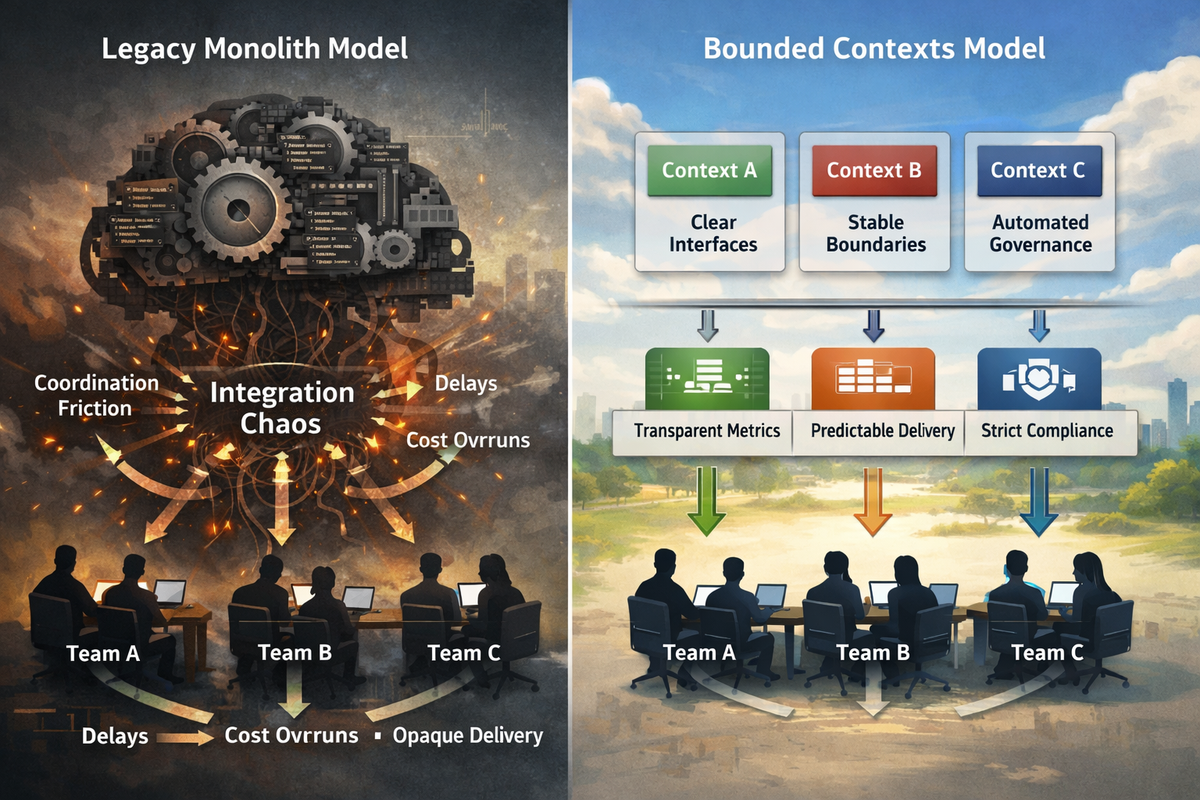
Monolith Gravity & Distributed Friction
TeamStation R&D · 11 MIN READ
Abstract
The operational discipline of Bounded Contexts is not a stylistic preference. It is an economic constraint. When Bounded Contexts are missing, integration becomes a permanent tax on velocity because every team boundary becomes a hidden API, every handoff becomes a translation layer, and every release becomes a negotiation.
This protocol analyzes the systemic failure modes associated with neglecting Bounded Contexts, validates the cost of inaction through TeamStation delivery doctrine, and provides a rigorous remediation framework that treats integration as physics, not personality. Where legacy vendors attempt to “manage integration” through meetings and staffing density, the doctrine treats integration as a governance problem solved through explicit boundaries, contract enforcement, and verification loops.
The underlying mechanism is measurable: when teams operate inside stable boundaries, coordination latency drops and rework rates fall. In platform-mediated delivery systems, this effect scales. TeamStation’s research on platform mediation and transaction-cost reduction supports this mechanism and its downstream operational outcomes (SSRN Ref: 5188490).
1. The Core Failure Mode: A Structural Autopsy
The industry default regarding Bounded Contexts is not merely inefficient. It is mathematically insolvent.
In the legacy staff augmentation model, vendors treat Bounded Contexts as negotiable. They promise to “align the team,” “improve communication,” and “tighten ceremonies.” This is a diagnostic error. Bounded Contexts are a boundary condition. When you ignore a boundary condition, you do not get a softer system. You get unbounded coupling.
The failure begins when organizations try to solve integration with headcount rather than architecture. Systems physics predicts the outcome. Adding mass to a high-friction system generates heat. In distributed delivery, that heat becomes Coordination Tax: the unlogged hours senior engineers spend clarifying intent, reconciling interfaces, rewriting integration glue, and de-risking releases that should have been correct by design.
This is why integration hell feels irrational. Your dashboards can look green. Your sprint burndown can look healthy. Tickets can move. But production outcomes stall because the system is burning energy at the seams. The visible work is not producing coherent movement.
You are likely experiencing this right now as Ghost Velocity. Jira is active. Standups are happening. Pull requests are merging. Yet integration remains the bottleneck, and shipping becomes a periodic crisis instead of a predictable flow. This is not a people problem. It is a protocol problem.
When Bounded Contexts are absent, your team is effectively running a high-concurrency distributed system without a synchronization lock. You get race conditions in the delivery pipeline: intent diverges from execution faster than the system can correct it.
If you want a concrete technical anchor for the failure pattern, start with the platform view of system design constraints and why coupling explodes at scale in distributed teams, then map that directly to integration load across services and domains (see the doctrine-backed architecture primitives in Axiom Cortex system design at system design constraints for distributed delivery).
2. Historical Analysis (2010–2026): Why Integration Became the Tax
To understand why Bounded Contexts are a tier-one constraint today, you have to compress the last decade of distributed engineering into what changed: the shape of coupling.
Phase 1: Wage Arbitrage (2010–2015)
Nearshore adoption was driven by hourly cost. Organizations implicitly assumed they could “buy inefficiency” because labor was cheaper. In 2010-era monoliths, that assumption sometimes survived. The system boundary was large, and integration happened inside one runtime and one release train.
But as software complexity increased, that tolerance collapsed. Cheap labor that breaks the build becomes infinitely expensive. The first place the cost showed up was integration. Teams could ship code locally, but they could not ship coherent outcomes across dependencies.
Phase 2: Staffing 2.0 (2015–2020)
Vendors pivoted. They promised culture-fit and soft-skill alignment. This improved surface communication but did not solve coupling. Integration shifted from “incompetence” to “misalignment.” Organizations hired senior engineers, but without stable boundaries, seniority simply produced faster divergence.
This is the historical point where “integration hell” became a normal operating condition: organizations had enough talent to build, but not enough structure to integrate.
Phase 3: Platform Governance (2020–Present)
We are now in the era of agentic tooling and AI-augmented delivery. Integration cannot be treated as artisanal craftsmanship. High-velocity teams need hard constraints so both humans and automation can operate safely.
The decade-long “trust me” vendor model is dead. It is being replaced by zero trust and continuous verification—the same evolution security made decades ago. TeamStation’s research frames this as platform mediation: when the platform enforces constraints, transaction costs fall and outcomes become predictable (SSRN Ref: 5188490). The delivery system becomes less dependent on heroics and more dependent on repeatable governance.
3. Systems Physics of the Solution: Boundary Enforcement, Not Hope
Bounded Contexts must be treated as engineering, not HR.
In a distributed system, reliability is a function of constraints. TeamStation’s doctrine states a simple principle: velocity is the derivative of constraint. This seems counterintuitive to organizations that equate freedom with speed, but every mature software system knows the opposite. Strict typing increases speed. Contract tests increase speed. Linting increases speed. Constraints reduce entropy.
The Entropy Vector
Left unmanaged, the team’s understanding of Bounded Contexts diverges. This is semantic entropy. And entropy is not a moral failure. It is a physics property. It increases unless energy is applied.
Legacy approaches apply energy through humans: more meetings, more documentation, more handoffs, more approval gates. That increases latency.
The doctrine approach applies energy through the pipeline: enforcement at the edge. If a commit violates boundary contracts, it is rejected early. That changes the feedback loop from “human review later” to “machine rejection now.”
This is why context boundaries must be expressed in forms automation can validate. The practical bridge is explicit interface discipline: service contracts, data ownership rules, and dependency direction.
For CTO-grade technical primitives that map directly to bounded contexts and integration safety, treat these as enforcement tools rather than “best practices”:
- Contract discipline via gRPC service boundaries as a coupling limiter (see gRPC contracts for inter-service stability)
- Boundary-safe API design to prevent implicit coupling across teams (see REST API design that resists drift)
- State isolation and replayable change control to reduce integration chaos (see event sourcing for deterministic integration)
- Service decomposition with explicit ownership (see microservices decomposition and boundary enforcement)
The Mathematical Model
Consider the cost function of Bounded Context failure:
C_f = (N × L) + R
Where:
- N = number of nodes (engineers/teams)
- L = latency of coordination across boundaries
- R = rate of rework caused by integration mismatch
In a legacy model without explicit boundaries:
- L is high (hours/days, often weekly cycles)
- R is high (commonly 30–40% in integration-heavy roadmaps)
As N grows, C_f grows nonlinearly because boundaries multiply faster than headcount. Every additional team adds edges to the integration graph.
By implementing boundary enforcement, you don’t “reduce integration pain.” You change the system’s scaling behavior:
- You push L downward via synchronous clarity and contract enforcement
- You push R downward via automated validation and ownership discipline
That decouples cost from scale.
The 4-Hour Horizon (Timezone Physics)
Boundaries reduce integration cost only if boundary disputes can be resolved inside a workable synchronicity window. When a debugging loop crosses too many time zones, latency spikes and coordination becomes multi-day.
This is why operational constraints like timezone overlap are not preferences. They are engineering requirements. When you build distributed pods, the overlap window determines whether integration issues resolve in hours or in weeks.
4. Risk Vector Analysis: How Integration Hell Destroys Valuation
When Bounded Contexts are neglected, the failure does not arrive as one big explosion. It arrives as compounding risk vectors.
Vector 1: Knowledge Silo
Without stable boundaries, knowledge accumulates in the heads of a few “integration heroes.” They become the human middleware. If they leave, they take execution capacity and institutional memory with them. This is key-person risk disguised as seniority.
Vector 2: The Latency Trap
As the system grows, lack of boundaries forces more synchronous coordination. Calendars fill up. Deep work disappears. Output declines even as activity increases. This creates the illusion of capacity while throughput collapses.
Vector 3: The Security Gap
Ambiguity creates security holes. Engineers bypass safeguards to meet deadlines. Permissions expand “temporarily,” then become permanent. Data residency and shadow IT problems emerge as downstream artifacts of integration panic.
Bounded Contexts close these vectors because they convert implicit assumptions into explicit contracts that can be verified.
5. Scientific Evidence: Platform Mediation Beats Vendor Theater
Legacy vendors sell hours. They do not sell constraints. This is why integration hell persists under staff augmentation: inefficiency is billable.
TeamStation’s research frames the solution as platform mediation: reduce transaction costs by enforcing governance through the platform, not through human negotiation (SSRN Ref: 5188490). This is structurally different from vendor management. It converts delivery from a linear queue into a parallel processing system where alignment is validated early, not discovered late (SSRN Ref: 5165433).
If you want the research spine behind the “platform vs vendor” distinction, anchor the doctrine to the research corpus rather than to opinion:
- Platform-first nearshore theory and governance implications (see platforming the nearshore industry research)
- Economic mechanisms behind predictable delivery under governance (see nearshore platform economics research)
- System architecture principles for cognitive + technical alignment (see Axiom Cortex architecture research)
This is what separates doctrine from blog content: claims are tied to mechanisms, and mechanisms are tied to published research artifacts.
6. Strategic Case Study: HealthTech Transformation (Constraint Restoration)
Context: A Series-C HealthTech platform based in Austin scaled engineering from 20 to 80 using a traditional nearshore vendor. Headcount increased. Deployment frequency dropped from weekly to monthly.
Diagnostic: Bounded Contexts were treated as an afterthought. Engineers were staffed for resume keywords, not for boundary discipline. Integration work consumed ~40% of senior engineering time, presenting as “Coordination Tax.”
Intervention: We implemented Monolith Gravity & Distributed Friction as a constraint-restoration protocol.
Calibration: We replaced subjective vetting with platform-mediated evaluation signals aligned to boundary thinking, supported by TeamStation’s Axiom Cortex doctrine (see Axiom Cortex overview).
Instrumentation: We enforced boundary contracts with CI/CD gating and observability-driven validation (see CI/CD enforcement primitives and Prometheus telemetry discipline).
Synchronization: We aligned pods to enforce overlap constraints so integration defects could be resolved synchronously, not asynchronously.
Outcome (90 days):
- Cycle time reduced by 65%
- Defect leakage dropped by 40% due to boundary enforcement
- Verification latency decreased from ~28 hours to ~3 hours because integration failures were detected earlier
This is the valuation lever. Integration becomes predictable when constraints become enforceable.
7. The Operational Imperative (CTO / CIO)
Stop treating integration as vendor management. It is system architecture.
Step 1: Instrument the Signal
You can’t fix what you can’t measure. Configure telemetry so you can see boundary violations, dependency churn, and integration failure hotspots. If you are relying on weekly status reports to understand integration health, you are already late.
Step 2: Enforce the Standard
Codify Bounded Contexts into your pipeline. Contract tests, dependency rules, ownership checks, and schema evolution policies must be gates, not guidelines.
Step 3: Align the Economics
Model the cost of integration failure explicitly. Teams often discover that “cheap” capacity without boundary discipline is more expensive in TCO than higher-signal capacity that protects integration integrity.
Step 4: The Talent Filter
When sourcing engineers, filter for boundary thinking and integration discipline. If an engineer cannot describe how they prevent coupling across domains, they will create coupling.
If you need an execution path into nearshore capacity that is aligned to your stack and boundary constraints, use country + technology hiring routes as governance primitives, not staffing pages. Example anchors:
- hire React engineers in Mexico with timezone overlap
- hire Node engineers in Colombia for integration-heavy products
- hire Java engineers in Brazil for service boundary modernization
8. 10 Strategic FAQs (Executive Briefing)
Q1: Why is Bounded Contexts a tier-one risk?
Because boundary failure propagates silently. By the time it appears in financial metrics, months of velocity have already been burned as integration rework.
Q2: How does TeamStation enforce Bounded Contexts?
By treating boundaries as enforceable contracts through platform governance, not as meeting topics.
Q3: Can we solve integration hell by hiring more managers?
No. More layers increase latency and distortion. You solve integration by reducing coupling and making contracts explicit.
Q4: What is the financial impact of ignoring Bounded Contexts?
It commonly manifests as 30–50% efficiency loss through rework and coordination. The spend is real; it’s just misclassified.
Q5: Does this apply to small teams?
Yes. Smaller teams are often more fragile because a single boundary failure consumes a larger percentage of total capacity.
Q6: How does AI change this problem?
AI accelerates everything, including chaos. Without boundaries, AI will generate integration debt faster than humans can contain it.
Q7: Is Bounded Contexts cultural or technical?
Both. The doctrine encodes culture into technical enforcement so behavior becomes system-stable.
Q8: How do we measure success?
Use DORA metrics: deployment frequency, lead time, change failure rate, MTTR. Activity metrics are noise.
Q9: Why do legacy vendors fail here?
Their model is body leasing. They monetize hours, not constraints. Inefficiency becomes billable.
Q10: What is the first step?
Audit where coupling is leaking value today. Identify the boundaries that exist only in people’s heads.
9. Systemic Execution Protocol
This protocol is non-negotiable. To operationalize Bounded Contexts immediately:
Talent Deployment: Deploy pre-vetted engineers aligned to boundary discipline through the executive control plane and evaluation systems (see Axiom Cortex evaluation architecture).
Strategy Alignment: Standardize bounded context patterns and contract rules across pods via CTO governance.
Economic Validation: Model the cost delta between governance enforcement and ad-hoc staff augmentation using platform economics research (see nearshore platform economics).
Status: PROTOCOL_ACTIVE
Authority: TeamStation AI · Scientific Doctrine Corpus