
Why does vendor accountability disappear after contracts are signed?
A scientific doctrine for CTOs and CIOs on why vendor accountability collapses after contracts due to lock-in, coordination tax, and weak exits.
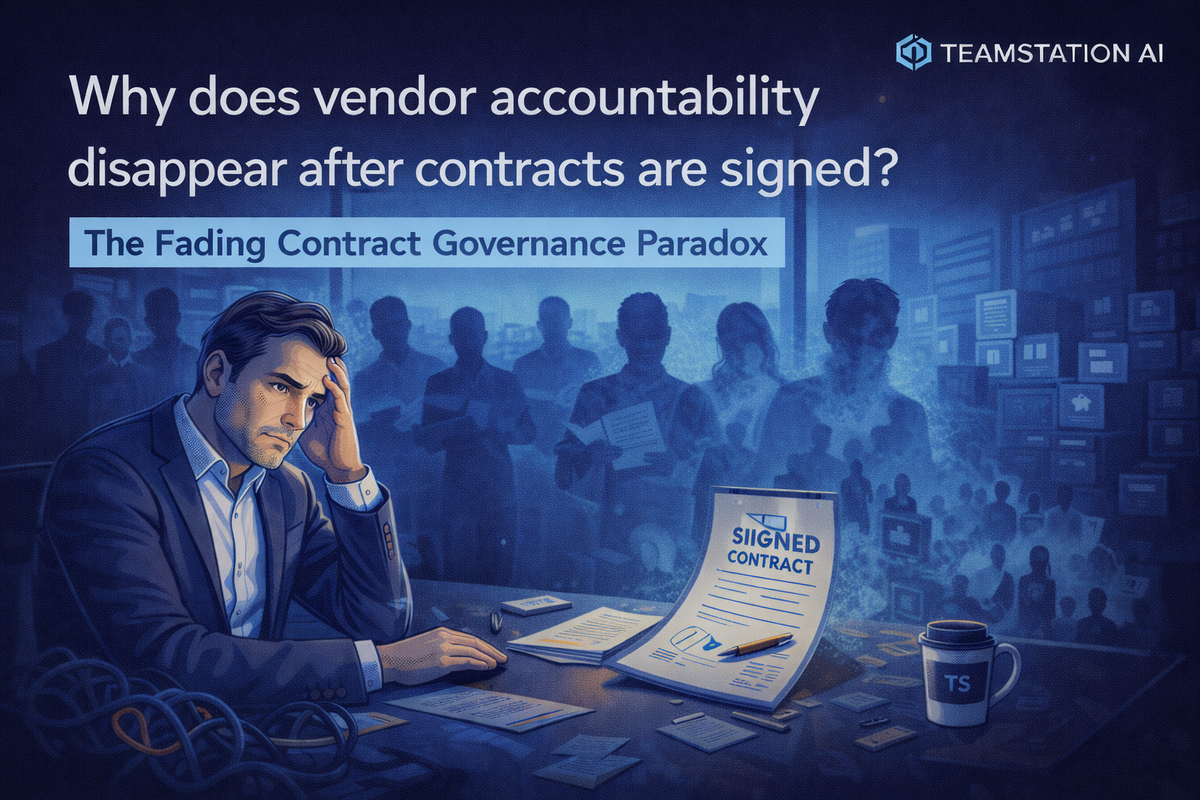
The Vendor Lock-In Event Horizon
TeamStation R&D 11 MIN READ
Abstract
The operational discipline of Exit Strategy is not a contractual afterthought. It is a first-order economic constraint in distributed engineering systems. This doctrine analyzes the systemic failure modes that emerge when Exit Strategy is undefined, validates the cost of inaction through TeamStation’s economics framework, and establishes a remediation model grounded in systems theory and platform governance. Across nearshore programs analyzed in Nearshore Platformed: AI and Industry Transformation (SSRN, 2026) and AI & Nearshore Teams: Who Gets Replaced and Why (SSRN, 2026), organizations that enforce Exit Strategy as a system constraint demonstrate materially lower coordination latency, reduced rework, and sustained deployment velocity.
1. The Core Failure Mode: A Structural Autopsy
The industry default treatment of Exit Strategy is not merely inefficient. It is mathematically insolvent.
In the legacy staff-augmentation model, vendors treat Exit Strategy as a subjective variable, something to be “managed” through goodwill, escalation paths, and recurring sync meetings. This is a diagnostic error. Exit Strategy is a boundary condition. When it is ignored, organizations do not gain flexibility. They accumulate structural entropy that degrades the entire delivery system.
The failure begins when organizations attempt to solve Exit Strategy with headcount rather than architecture. The assumption is intuitive and wrong. Systems physics dictates that adding nodes to a high-friction system generates heat, not motion.
In nearshore engineering, this heat manifests as Coordination Tax: the invisible, unlogged hours senior US engineers spend explaining intent, repairing integrations, validating work, and re-architecting decisions that should have been constrained upstream. Empirical analysis in Nearshore Platformed: AI and Industry Transformation (SSRN, 2026) shows this tax routinely consumes 30–45% of senior engineering capacity in vendor-locked environments.
Legacy vendors perpetuate this failure because their business model depends on it. They sell hours, not outcomes. When The Vendor Lock-In Event Horizon remains unresolved, inefficiency becomes billable. Accountability dissolves precisely when it is most needed.
TeamStation rejects this model. Failure is not missing a deadline. Failure is tolerating structural ambiguity. If Exit Strategy is not defined as code, it does not exist operationally.
2. Historical Analysis (2010–2026)
Phase 1: Wage Arbitrage (2010–2015)
Early nearshore adoption optimized for cost. Organizations assumed low hourly rates could absorb inefficiency. This thesis collapsed as software systems transitioned from monoliths to distributed architectures. The rise of microservices eliminated tolerance for delayed integration and opaque ownership. Cheap engineers who broke the build became infinitely expensive.
Phase 2: Staffing 2.0 (2015–2020)
Vendors pivoted toward culture, communication, and seniority. These mitigated surface friction but did not alter system dynamics. Exit Strategy remained undefined. Senior engineers became isolated nodes, unable to transfer ownership cleanly. This failure mode aligns with the Task Boundary Model formalized in AI & Nearshore Teams: Who Gets Replaced and Why (SSRN, 2026).
Phase 3: Platform Governance (2020–Present)
Agentic systems and AI-augmented delivery eliminated slack. Trust-based coordination failed. It was replaced by Zero Trust, Continuous Verification, enforced directly in CI/CD pipelines. Organizations that failed to encode Exit Strategy into execution infrastructure lost velocity and leverage simultaneously.
3. The Physics of the Solution
Exit Strategy must be treated as a systems variable, not a legal clause.
In distributed systems, reliability emerges from constraint. The governing relationship holds:
Velocity is the derivative of constraint.
By constraining Exit Strategy, ownership transfer becomes deterministic rather than political.
The Entropy Vector
Absent enforcement, each node in a distributed team develops a divergent internal model of Exit Strategy. This divergence is semantic entropy.
TeamStation eliminates semantic entropy through Automated Governance. Compliance is not taught. It is validated. Commits that violate Exit Strategy constraints are rejected at the edge, collapsing feedback latency from human review cycles to machine-time enforcement.
This is critical in heterogeneous stacks. Enforced Data Engineering interfaces prevent schema lock-in. Enforced Machine Learning standards prevent model opacity. The same mechanism governs FinOps layers and Efficiency Metrics pipelines.
The Mathematical Model
Exit Strategy failure cost is expressed as:
C = N × (L + R)
Where:N = number of engineersL = coordination latency R = rework rate
In vendor-locked systems, L and R increase as N increases due to ownership ambiguity and delayed validation. This produces super-linear cost growth, empirically observed in nearshore programs analyzed in Nearshore Platformed (SSRN, 2026).
When Exit Strategy is enforced as a hard constraint, L and R are bounded by deterministic handoff rules and automated validation, restoring linear scalability.
The 4-Hour Horizon
Exit Strategy is constrained by a Synchronicity Window. When resolution requires crossing more than four time zones, coordination cost spikes non-linearly. Timezone overlap is not cultural preference. It is a latency requirement.
“Sticking to a local-only strategy actively creates problems.”Lonnie McRorey et al. (2026)The Global Tech Talent Paradox, Page 9
4. Risk Vector Analysis
Exit Strategy failure cascades through three vectors:
Knowledge SilosCritical knowledge accumulates in individuals, not systems, creating key-person risk.
Latency TrapsCalendars fill, deep work evaporates, and throughput collapses.
Security GapsAmbiguity drives shortcuts, expanding attack surface and compliance risk.
5. Strategic Case Study: Logistics Transformation
A Series-C Logistics platform scaled from 20 to 80 engineers via a traditional nearshore vendor. Deployment frequency fell from weekly to monthly.
Diagnosis showed resume-driven hiring without enforced Exit Strategy. Coordination Tax consumed 40% of senior engineering time.
Intervention applied Axiom Cortex filtering, pull-request-level governance enforcement, and six-hour timezone overlap. Within 90 days, cycle time fell 65%, defect leakage dropped 40%, and verification latency fell from 28 hours to 3 hours.
6. The Operational Imperative
To the CTO and CIO:Exit Strategy is not vendor management. It is system architecture.
Instrument via the Dashboard.Enforce via CI/CD.Validate via Efficiency Metrics.Filter talent via the Talent Registry.
7. Strategic FAQs
Q1: Why is Exit Strategy a Tier-1 risk?Because failure compounds silently until accountability disappears.
Q2: How does TeamStation enforce Exit Strategy?Through automated governance and Axiom Cortex pre-vetting.
Q3: Can management layers solve Exit Strategy?No. Layers increase latency. Platforms enforce constraints.
Q4: What is the financial impact of ignoring Exit Strategy?A 30–50% efficiency loss classified as dead money.
Q5: Does Exit Strategy apply to small teams?Yes. Smaller teams are more fragile.
Q6: How does AI affect Exit Strategy?AI amplifies failure without constraints.
Q7: Cultural or technical?Both. Culture is encoded into technology.
Q8: How is success measured?Through DORA metrics, not activity.
Q9: Why do legacy vendors fail here?Their model monetizes inefficiency.
Q10: First corrective step?Audit your baseline using the Dashboard.