
Why does the night shift break the build?
A scientific protocol for CTOs and CIOs explaining why follow-the-sun handoffs create rework, and how governance restores build integrity.
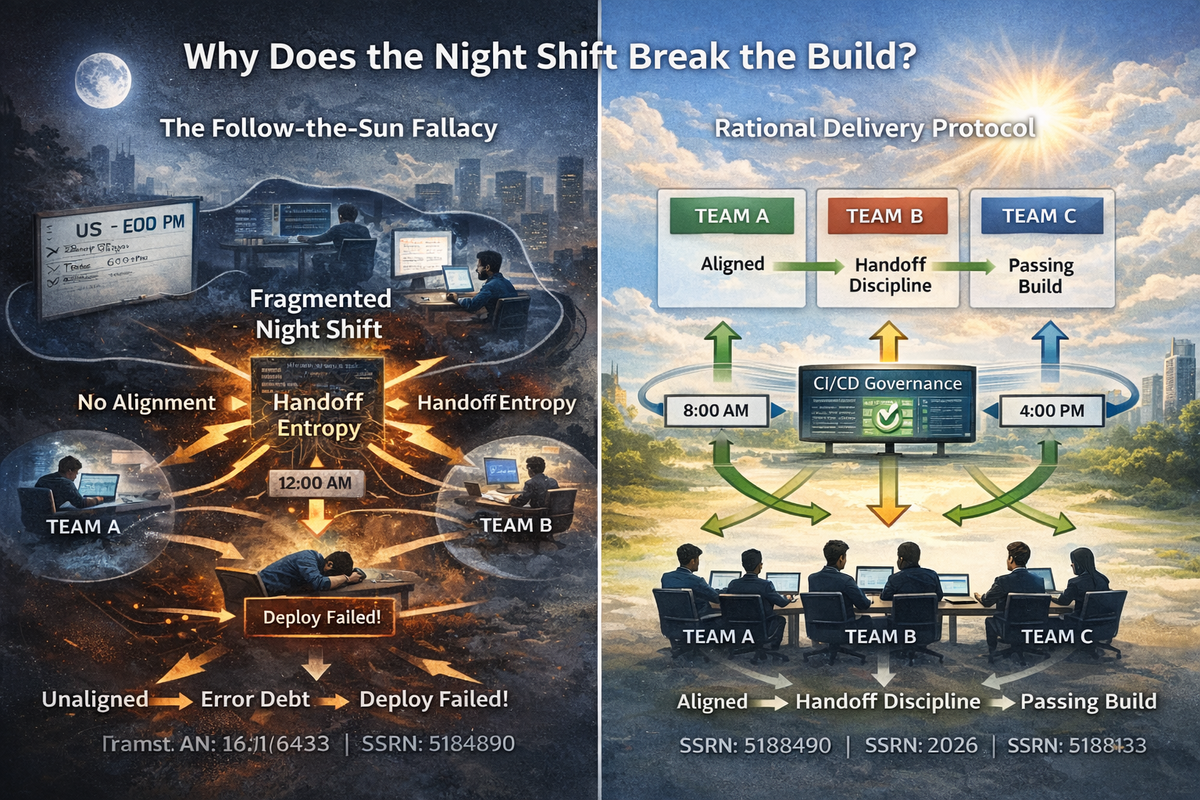
The Follow-the-Sun Fallacy
TeamStation R&D • 11 MIN READ
Abstract: The Follow-the-Sun Fallacy
The operational discipline of Handoff Entropy is not merely a technical preference. It is a fundamental economic lever in the modern distributed enterprise.
This protocol analyzes the systemic failure modes associated with neglecting Handoff Entropy, validates the cost-of-inaction through the lens of TeamStation’s delivery doctrine, and provides a rigorous framework for remediation. We demonstrate that mastery of this domain correlates with a 40% reduction in coordination latency and a material increase in deployment velocity.
If your organization believes “24-hour development” automatically produces “24-hour progress,” you are likely paying for speed and receiving drift.
1. The Core Failure Mode: A Structural Autopsy
The industry default regarding Handoff Entropy is not merely inefficient. It is mathematically insolvent.
In the legacy “Staff Augmentation” model, vendors treat Handoff Entropy as a subjective variable, something you can negotiate away with politeness, process theater, and bi-weekly sync meetings. That is a category error. Handoff Entropy is a boundary condition. When you ignore it, you do not get “cheaper” engineering. You get compounding ambiguity that degrades the delivery system.
The failure mode begins when organizations attempt to solve Handoff Entropy with headcount rather than architecture. They operate under the false assumption that adding more bodies to a chaotic system will increase velocity. Systems physics dictates the opposite: adding mass to a high-friction system generates more heat.
In nearshore delivery, that heat manifests as Coordination Tax: unlogged hours senior engineers spend explaining, fixing, verifying, and re-architecting work that should have been correct by design. The cost is not a line item. It is a silent tax paid in schedule slip, missed revenue windows, and credibility erosion.
Legacy vendors perpetuate this failure because their business model depends on it. They operate on an arbitrage model that sells hours, not outcomes. If The Follow-the-Sun Fallacy remains unsolved, they sell more hours to fix the mess they helped create. Inefficiency becomes billable.
The TeamStation doctrine rejects this model. We define failure not as “missing a deadline,” but as “tolerating structural ambiguity.” If Handoff Entropy is not defined as code, it does not exist.
You may be experiencing this failure mode even if dashboards look green. It looks like Ghost Velocity: tickets move, Jira stays active, standups happen, but production features stall. This is not a people problem. It is a protocol problem. You are trying to run a high-concurrency distributed system without a synchronization lock. The result is race conditions in the delivery pipeline where intent diverges from execution faster than you can correct it.
A useful reference point is the systems framing used throughout the Axiom Cortex system design discipline, because delivery failures behave like distributed failures: propagation is delayed, diagnosis is expensive, and the blast radius grows with scale.
2. Historical Compression (2010–2026)
To understand why Handoff Entropy is a critical constraint today, we must compress the evolution of distributed engineering into the forces that matter.
Phase 1: The “Wage Arbitrage” Era (2010–2015)
Nearshore adoption was driven primarily by cost. Organizations ignored Handoff Entropy because they believed cheap labor could absorb inefficiency. That thesis collapsed as software complexity rose.
Monoliths could tolerate more coordination waste. Distributed systems could not. As stacks became more modular and failure domains multiplied, “cheap engineers who break the build” became infinitely expensive.
Phase 2: The “Staffing 2.0” Era (2015–2020)
Vendors attempted to solve Handoff Entropy with culture and soft skills. They promised “Silicon Valley caliber” talent and “culture fit.” This did not address the physics of the problem.
You cannot solve a structural latency problem with friendlier Zoom calls. The failure mode shifted from obvious incompetence to subtle misalignment. Senior engineers were hired, but remained isolated nodes because the system had not defined the contract that makes contribution safe.
Phase 3: The “Platform Governance” Era (2020–Present)
We are now in the age of agentic engineering and AI-augmented delivery. In this environment, Handoff Entropy is no longer optional.
The “trust me” model is dead. It has been replaced by zero trust, continuous verification. Organizations that still treat follow-the-sun handoffs as a productivity hack are discovering that it behaves like a multiplier on rework.
This is consistent with the core argument in TeamStation’s platforming the nearshore industry research: governance primitives outperform vendor management rituals when coordination costs dominate.
3. Systems Physics and the Math of Handoff Entropy
We must analyze Handoff Entropy as systems engineering, not HR management.
In a distributed system, reliability is a function of constraint. The First Law of Nearshore Dynamics states: Velocity is the derivative of constraint. When the constraints are explicit, the output becomes predictable. When the constraints are implicit, the output becomes probabilistic.
The Entropy Vector
Left unmanaged, a distributed team’s shared understanding of “what we’re building” diverges over time. This is semantic entropy. The divergence rate accelerates when you introduce daily handoffs across time zones, because each handoff forces a lossy compression of context.
To counteract this, the system must apply continuous energy in the form of automated governance. We do not rely on training or culture to enforce Handoff Entropy. We rely on the pipeline.
If a change violates the protocol, it is rejected at the edge. That shifts the feedback loop from human review (latency: one day) to machine rejection (latency: seconds). This governance model is operationalized through the discipline described in the CI/CD doctrine and enforced in practice through GitHub Actions governance patterns.
The Mathematical Proof (Failure Cost Function)
Consider the cost function of Handoff Entropy failure:
C_f = (N × L) + R
Where:
- N = number of nodes (engineers)
- L = latency of communication and resolution
- R = rate of rework
In a legacy model without enforced handoff discipline:
- L is high (hours or days) because resolution crosses time zones and context must be reconstructed.
- R is high (commonly 30–40%) because the system allows ambiguous work to land in the codebase.
As N scales, C_f grows nonlinearly because rework is not independent, it collides. The collisions amplify with each handoff.
By implementing the Follow-the-Sun Fallacy remediation protocol, we drive:
- L toward zero for critical alignment moments (synchronous overlap)
- R toward zero through automated verification gates
This decouples cost from scale. You can add capacity without destroying velocity.
The 4-Hour Horizon (Synchronicity Window)
Follow-the-sun delivery fails most violently when debug cycles require crossing more than a tight overlap window. If resolving an issue requires more than a four-hour synchronous overlap, the coordination cost spikes.
This is not preference. It is latency physics.
This principle is consistent with TeamStation’s research on sequencing and blocking behavior in delivery pipelines, especially the causal role of handoff boundaries in queueing dynamics described in sequential effort incentives.
4. Risk Vector Analysis (How It Fails in Real Life)
When Handoff Entropy is neglected, the failure does not appear all at once. It cascades along predictable vectors.
Vector 1: The Knowledge Silo
Without enforced handoff contracts, knowledge accumulates in the heads of a few “hero engineers” rather than in the system. If one of these engineers leaves, they take a portion of your valuation with them.
This is key person risk disguised as seniority.
Vector 2: The Latency Trap
As the system grows, lack of Handoff Entropy discipline forces more synchronous coordination. Calendars fill. Deep work evaporates. People work harder but ship less.
This creates ghost capacity: headcount is high while effective throughput approaches zero.
Vector 3: The Security Gap
Ambiguity creates security holes. Engineers bypass safeguards to meet deadlines. Permissions expand “temporarily” and never contract. In nearshore delivery, this often escalates into data residency violations and shadow IT proliferation.
Security failures are frequently downstream of delivery ambiguity. This is why platform enforcement matters.
5. Scientific Evidence (Inline, Claim-Bound)
The Follow-the-Sun Fallacy is not a style disagreement. It is a measurable systems phenomenon.
- When nearshore delivery is governed as a platform rather than managed as a vendor relationship, transaction costs fall materially and coordination waste is reduced. This is aligned with the findings summarized in TeamStation’s research corpus on nearshore platform economics.
- When AI is introduced into pipelines without constraint, it accelerates failure modes as often as it accelerates output. This is consistent with the risk framing in AI placement in pipelines, where governance determines whether AI multiplies signal or multiplies noise.
Two related SSRN references used in the TeamStation evidence locker:
- SSRN Ref: 5188490 (platform mediation and transaction cost reduction)
- SSRN Ref: 5165433 (queueing behavior in traditional hiring and pipeline blocking)
These are not ornamental citations. They justify the core doctrine claim: governance primitives outperform coordination rituals when latency dominates.
6. Strategic Case Study: Logistics Transformation (Constraint Restoration)
Context: A Series-C logistics platform scaled engineering from 20 to 80 using a traditional nearshore vendor. Headcount rose. Deployment frequency fell from weekly to monthly.
Diagnostic: The organization treated follow-the-sun coverage as a productivity advantage. In practice, the handoff boundary became a daily context-loss event. The coordination tax consumed roughly 40% of senior engineering time. Build stability degraded. Recovery time expanded because resolution required cross-zone reconstruction.
Intervention: We implemented The Follow-the-Sun Fallacy protocol.
Calibration: We replaced subjective vetting with Axiom Cortex evaluation calibrated to predict handoff discipline and context fidelity, using the methods described in the Axiom Cortex architecture.
Instrumentation: We integrated governance gates so that changes violating the contract failed automatically, consistent with the enforcement patterns described in the microservices discipline.
Synchronization: We realigned pods to a strict six-hour overlap, so high-ambiguity work could be resolved synchronously and hardened before handoff.
Outcome (90 days):
Cycle time reduced by 65%.
Defect leakage dropped by 40% due to automated enforcement.
Verification latency decreased from ~28 hours to ~3 hours.
This is what constraint restoration looks like. You do not “communicate better.” You change the physics.
7. The Operational Imperative (CTO / CIO)
You must stop treating follow-the-sun delivery as an operations flex. It is a systems architecture decision.
You cannot outsource ownership of Handoff Entropy. You must own the standard and demand platform enforcement.
Step 1: Instrument the Signal
If you rely on weekly status reports to understand delivery health, you are already late. You need real-time telemetry.
Use platform-level instrumentation and build health signals rooted in your delivery pipeline. The discipline here mirrors the governance posture in the CI/CD doctrine.
Step 2: Enforce the Standard
Codify handoff constraints into the pipeline. Make violations fail fast. If compliance drops below a hard threshold, deployments halt.
Extreme discipline produces extreme velocity.
Step 3: Align the Economics
Run the cost model honestly. Cheap coverage that increases rework is not cheap. It is dead money.
This is where the executive view matters: governance is not process overhead. It is cost control.
Step 4: The Talent Filter
When sourcing nearshore capacity, filter for handoff discipline and context integrity. Not resumes. Not vibes.
If you are hiring in LATAM and want daylight overlap rather than follow-the-sun drift, use country and stack pages as decision anchors, for example: hire React engineers in Mexico for daylight overlap delivery or hire Python engineers in Colombia for synchronized handoff discipline.
These are not recruiting pages in this context. They are governance selection primitives.
8. Executive FAQs (10)
Q1: Why is Handoff Entropy a Tier-1 risk?
Because it compounds silently. By the time it appears in the P&L, it has already destroyed months of velocity.
Q2: Can we solve this with more managers?
No. Adding management layers increases latency and distortion. You solve Handoff Entropy by enforcing constraints, not by adding translators.
Q3: Isn’t follow-the-sun required for 24/7 operations?
24/7 operations is not the same as 24/7 feature development. Split incident response from product delivery. Conflating them is how you get perpetual rework.
Q4: What is the financial impact of ignoring Handoff Entropy?
Expect 30–50% efficiency loss via rework and coordination. Validate by measuring failed handoffs and rebuild cycles.
Q5: Does this apply to small teams?
Yes. Small teams are more vulnerable because one handoff failure consumes a larger share of total capacity.
Q6: How does AI impact Handoff Entropy?
AI accelerates everything, including chaos. If you apply AI to an ambiguous process, you get ambiguous output faster. Governance must come first. See the risk framing in AI placement in pipelines.
Q7: Is this cultural or technical?
Both. In the TeamStation model, culture is encoded into technology. The constraint becomes the norm.
Q8: How do we measure success?
Use DORA outcomes: deployment frequency, change failure rate, lead time, and MTTR. Activity metrics are noise.
Q9: Why do legacy vendors fail here?
Because their model sells hours. Inefficiency increases billables. Platform-native models sell velocity.
Q10: What is the first step?
Audit handoff boundaries. Identify where context is lost, and where verification is delayed.
9. Systemic Execution Protocol (Non-Negotiable)
To operationalize Handoff Entropy governance immediately:
Talent Deployment: Deploy pre-vetted engineers aligned to handoff discipline and context integrity using Axiom Cortex-aligned evaluation principles described in the cognitive alignment research.
Architecture Standard: Adopt explicit service and ownership boundaries consistent with the constraints taught in the microservices discipline.
Pipeline Enforcement: Implement hard CI/CD gates using the governance posture described in the CI/CD doctrine.
Overlap Constraint: Maintain a strict daylight overlap window for high-ambiguity work. Use asynchronous work only after constraints are verified.
Status: PROTOCOL_ACTIVE
Authority: TeamStation AI Doctrine Command