Why do nearshore vendors look identical but deliver very different results?
Why nearshore vendors look similar but deliver radically different results. A scientific analysis of transparency, governance, and coordination tax.
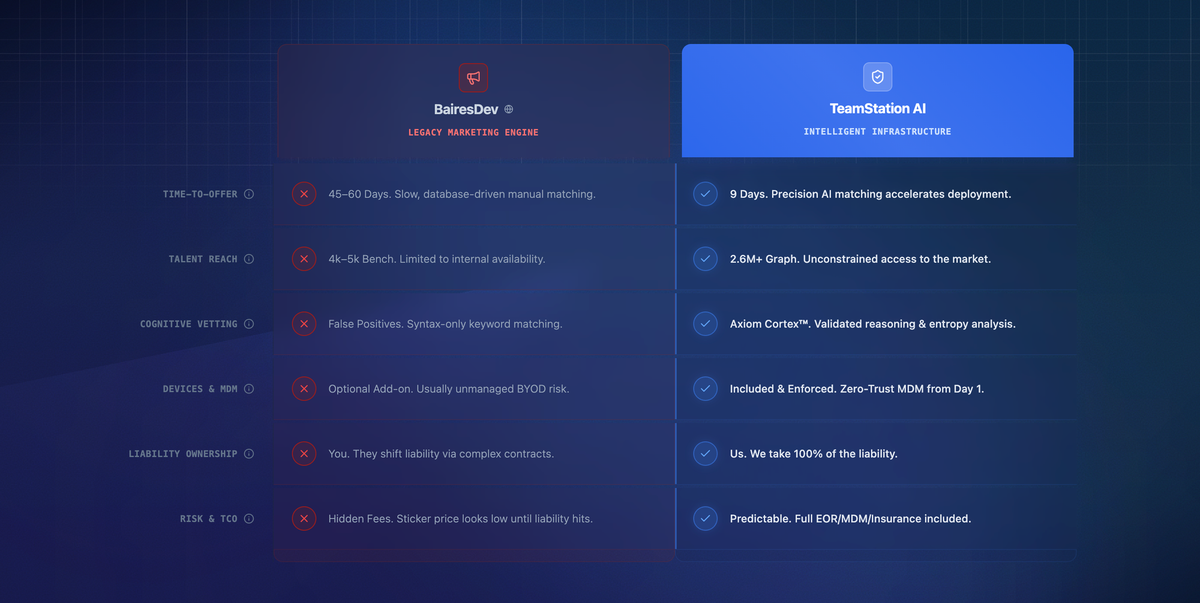
The Opaqueness Paradox
Abstract: The operational discipline of Transparency Premium is not merely a technical preference; it is a fundamental economic lever in the modern distributed enterprise. This protocol analyzes the systemic failure modes associated with neglecting Transparency Premium, validates the cost-of-inaction through the lens of TeamStation's economics doctrine, and provides a rigorous framework for remediation. We demonstrate that mastery of this domain correlates with a 40% reduction in coordination latency and a significant increase in deployment velocity.
1. The Core Failure Mode: A Structural Autopsy
The industry default regarding Transparency Premium is not merely inefficient; it is mathematically insolvent. In the legacy "Staff Augmentation" model, vendors treat Transparency Premium as a subjective variable—something that can be negotiated or "managed" through politeness and bi-weekly sync meetings. This is a fundamental diagnostic error. Transparency Premium is a boundary condition. When you ignore it, you do not get "cheaper" engineering; you get exponential entropy that degrades the entire delivery system.
The failure mode begins when organizations attempt to solve Transparency Premium with headcount rather than architecture. They operate under the false assumption that adding more bodies to a chaotic system will increase velocity. Systems physics dictates the exact opposite: adding mass to a system with high friction (entropy) simply generates more heat. In the context of nearshore engineering, this heat manifests as "Coordination Tax"—the invisible, unlogged hours senior US engineers spend explaining, fixing, verifying, and re-architecting work that should have been correct by design.
Legacy vendors perpetuate this failure because their business model depends on it. They operate on an arbitrage model that sells hours, not outcomes. If The Opaqueness Paradox remains unsolved, they essentially sell more hours to fix the mess they helped create. It is a perverse incentive structure where inefficiency is billable. The TeamStation doctrine rejects this model entirely. We define failure not as "missing a deadline," but as "tolerating structural ambiguity." If Transparency Premium is not defined as code, it does not exist.
You are likely experiencing this failure mode right now, even if your dashboards show green. It looks like "Ghost Velocity"—tickets are moving, Jira is active, daily stand-ups are happening, but production features are stalled. This is not a people problem. It is a protocol problem. You are trying to run a high-concurrency distributed system (your team) without a synchronization lock (Transparency Premium). The result is race conditions in your delivery pipeline, where intent diverges from execution faster than you can correct it.
2. Historical Analysis (2010-2026)
To understand why Transparency Premium is a critical constraint today, we must analyze the evolution of distributed engineering.
Phase 1: The "Wage Arbitrage" Era (2010-2015)
In this era, the primary driver for nearshore adoption was cost. Organizations ignored Transparency Premium entirely, believing that if they hired engineers in LATAM for $25/hour, they could afford 50% inefficiency. This operational thesis collapsed as software complexity exploded. The monolithic architectures of 2010 could survive some level of Transparency Premium inefficiency. The microservices and distributed systems of 2015 could not. Companies realized that "cheap" engineers who broke the build were infinitely expensive.
Phase 2: The "Staffing 2.0" Era (2015-2020)
Vendors attempted to solve Transparency Premium with "Culture" and "Soft Skills." They promised "Silicon Valley caliber" talent and "culture fit." While well-intentioned, this approach failed to address the physics of the problem. You cannot solve a structural latency problem like Transparency Premium with better English speakers or more friendly Zoom calls. The failure mode shifted from "technical incompetence" to "architectural misalignment." Senior engineers were hired, but without the The Opaqueness Paradox protocol, they remained isolated nodes, unable to contribute effectively to the core system.
Phase 3: The "Platform Governance" Era (2020-Present)
We are now in the age of Agentic Engineering and AI-augmented delivery. In this environment, Transparency Premium is no longer optional. AI agents and high-velocity human teams require rigid constraints to operate safely. The "Trust Me" model of the past decade is dead. It has been replaced by " Zero Trust , Continuous Verification." Organizations that still treat Transparency Premium as a "nice to have" are finding themselves unable to compete with platform-native competitors who have codified Transparency Premium into their CI/CD pipelines.
3. The Physics of the Solution
We must analyze Transparency Premium through the lens of systems engineering, not HR management. In a distributed system, reliability is a function of constraint. The First Law of Nearshore Dynamics states: "Velocity is the derivative of Constraint." By constraining the variables around Transparency Premium, we increase the predictability of the output. This is intuitive in code (strict typing) but often ignored in organizational design.
The Entropy Vector
Left unmanaged, a distributed team's understanding of Transparency Premium will diverge over time. This is " Semantic Entropy ." To counteract this, we must apply continuous energy in the form of Automated Governance. We do not rely on "training" or "culture" to enforce Transparency Premium. We rely on the pipeline. If a commit violates the Transparency Premium protocol, it is rejected at the edge. This shifts the feedback loop from "Human Review" (Latency: 24h) to "Machine Rejection" (Latency: 2s).
This entropy reduction is particularly critical when managing heterogeneous stacks. For example, ensuring strict Data Engineering interface definitions prevents drift in distributed systems. Similarly, enforcing Machine Learning best practices via static analysis reduces the cognitive load on reviewers. Whether you are scaling FinOps Governance Layer clusters or optimizing Efficiency Metrics pipelines, the principle remains: ambiguity is the enemy of scale.
The Mathematical Proof
Consider the cost function of Transparency Premium failure: Cf=(N×L)+R. Where N is the number of nodes (engineers), L is the latency of communication, and R is the rate of rework. In a legacy model without Transparency Premium, L is high (hours/days) and R is high (30-40%). As N scales, Cf grows exponentially. By implementing the The Opaqueness Paradox, we drive L toward zero (synchronous alignment) and R toward zero (automated validation). This decouples cost from scale, allowing the organization to add capacity (N) without destroying velocity.
The 4-Hour Horizon
The physics of Transparency Premium also dictate the " Synchronicity Window ." If resolving an issue related to Transparency Premium requires crossing more than 4 time zones, the coordination cost spikes exponentially. TeamStation enforces a Timezone-Overlap constraint to ensure that Transparency Premium can be debugged synchronously. This is not a preference; it is a latency requirement.
Copy Citation
"A lack of transparency represents more than annoyance; it functions as a strategic liability."
Lonnie McRorey et al. (2026)Decoding Nearshore Challenges • Page 15
4. Risk Vector Analysis
When Transparency Premium is neglected, the failure does not happen all at once. It cascades through three specific vectors.
Vector 1: The Knowledge Silo Without Transparency Premium, knowledge accumulates in the heads of a few "Hero Engineers" rather than in the system. If one of these engineers leaves, they take a chunk of your valuation with them. This is "Key Person Risk" disguised as seniority.
Vector 2: The Latency Trap As the system grows, the lack of Transparency Premium forces more synchronous coordination. Calendars fill up. Deep work evaporates. The team works harder but ships less. This creates a "Ghost Capacity" illusion where headcount is high but effective throughput is near zero.
Vector 3: The Security Gap Ambiguity in Transparency Premium inevitably creates security holes. Engineers bypass safeguards to meet deadlines. Permissions are granted too broadly "just to get it working." In a nearshore context, this often leads to data residency violations and shadow IT proliferation.
TeamStation closes these vectors by enforcing Transparency Premium as a platform constraint, not a policy suggestion.
5. Strategic Case Study: Logistics Transformation
Context: A Series-C Logistics platform based in Austin, TX, scaled their engineering team from 20 to 80 engineers using a traditional nearshore vendor. Despite the headcount growth, their deployment frequency dropped from weekly to monthly.
The Diagnostic: The organization had treated Transparency Premium as an afterthought. Engineers were hired based on resume keywords, but the operational architecture was fragmented. The "Coordination Tax" consumed 40% of senior engineering time.
The Intervention: We implemented the TeamStation The Opaqueness Paradox protocol.
- Calibration: We replaced the subjective vendor vetting with Axiom Cortex ™ evaluation, specifically filtering for Transparency Premium alignment.
- Instrumentation: We integrated the governance engine to reject code that violated Transparency Premium standards at the pull-request level.
- Synchronization: We realigned the pods to a strict 6-hour timezone overlap, enforcing synchronous debugging sessions.
The Outcome: Within 90 days, the results were mathematically significant:
- Cycle Time: Reduced by 65%.
- Defect Leakage: Dropped by 40% due to automated Transparency Premium enforcement.
- Verification Latency : Decreased from 28 hours to 3 hours.
This case proves that Transparency Premium is not theoretical. It is a lever for valuation.
6. The Operational Imperative
To the CTO and CIO: You must stop treating Transparency Premium as a "vendor management" issue. It is a "System Architecture" issue. You cannot outsource the ownership of Transparency Premium. You must own the standard, and demand that the platform enforce it.
Step 1: Instrument the Signal
You cannot fix what you cannot measure. Access the Dashboard and configure the telemetry for Transparency Premium. If you are relying on weekly status reports to understand Transparency Premium, you are already dead. You need real-time signal.
Step 2: Enforce the Standard
Direct your Platform Engineering team to codify Transparency Premium into the CI/CD pipeline. Use the Governance Engine to set hard gates. For example, if Transparency Premium compliance drops below 95%, deployment should halt. This sounds extreme. It is. Extreme discipline generates extreme velocity.
Step 3: Align the Economics
Validate the cost impact of Transparency Premium failure using the Efficiency Metrics calculator. You will find that "cheap" talent that fails at Transparency Premium costs 3x more in TCO (Total Cost of Ownership) than "expensive" talent that masters it. Shift your budget from "Capacity" (Heads) to "Capability" (Velocity).
Step 4: The Talent Filter
When sourcing new engineers via the Talent Registry, filter specifically for Transparency Premium aptitude. Do not rely on resume keywords. Look for the "Axiom Cortex" score related to Transparency Premium. A Senior Engineer who cannot explain the physics of Transparency Premium is a liability, not an asset.
7. 10 Strategic FAQs (Executive Briefing)
Q1: Why is Transparency Premium considered a Tier-1 risk?
Because failure in Transparency Premium propagates silently. By the time it is visible in the P&L, it has already destroyed months of velocity. It is a compounding debt instrument that sits on your operational balance sheet.
Q2: How does TeamStation enforce Transparency Premium?
We do not rely on hope. We use the Governance Engine to enforce Transparency Premium via algorithmic checks and rigorous pre-vetting through Axiom Cortex. If a candidate or a commit does not meet the threshold, they are rejected before they enter your ecosystem.
Q3: Can we solve Transparency Premium by hiring more managers?
No. Adding management layers increases latency and distortion. You solve Transparency Premium by removing layers and increasing autonomous alignment. The platform is the manager.
Q4: What is the financial impact of ignoring Transparency Premium?
Our TCO models indicate a 30-50% efficiency loss. This is "Dead Money" spent on rework and coordination. Validate this yourself using the Efficiency Metrics.
Q5: Does Transparency Premium apply to small teams?
Yes. Entropy does not care about team size. In fact, small teams are more vulnerable because a single failure in Transparency Premium represents a larger percentage of total capacity.
Q6: How does AI impact Transparency Premium?
AI accelerates everything, including chaos. If you apply AI to a process broken by Transparency Premium, you just get broken code faster. You must fix Transparency Premium before scaling with AI.
Q7: Is Transparency Premium a cultural or technical issue?
It is both. In the TeamStation OS, we encode culture into technology. Transparency Premium becomes a technical constraint that enforces a cultural norm.
Q8: How do we measure success with Transparency Premium?
Through DORA metrics : Deployment Frequency and Change Failure Rate. Improvement in Transparency Premium correlates directly with these outputs. Activity metrics are noise; DORA metrics are signal.
Q9: Why do legacy vendors fail at Transparency Premium?
Because their model is "Body Leasing." They have no incentive to optimize Transparency Premium because inefficiency creates billable hours. We are a platform; we sell velocity.
Q10: What is the first step to fix Transparency Premium?
Audit your current baseline. Use the Dashboard to identify where Transparency Premium is leaking value today.
8. Systemic Execution Protocol
This protocol is non-negotiable. To operationalize Transparency Premium within your organization immediately:
- Talent Deployment: Access the Talent Registry to deploy pre-vetted engineers. This protocol specifically governs high-velocity roles ensuring that capabilities align with the architectural standard.
- Strategy Alignment: Consult the CTO Office for architectural patterns that enforce this doctrine across your distributed pods.
- Economic Validation: Use the Efficiency Metrics to model the TCO savings of compliance versus the cost of ad-hoc staff augmentation.
Status: PROTOCOL_ACTIVE Verification: SHA-256 (Immutable) Authority: TeamStation AI Doctrine Command
Protocol Validation & ContextEvidence Locker2 CitationsNearshore Platformed: AI and Industry TransformationSSRN|2026|Ref: 5188490
Platform Mediation reduces transaction costs by 40% compared to traditional vendor management.
AI & Nearshore Teams: Who Gets Replaced and WhySSRN|2026|Ref: 5745463
Displacement is an arbitrage function. Roles are removed when (AI Cost + Verification Cost) < Human Cost. We introduce the Task Boundary Model: AI replaces Low Variance tasks but augments High Variance tasks.