
Why Are Stand-ups Useless?
Why daily stand-ups fail to improve delivery. A scientific analysis of Zombie Scrum, coordination tax, and platform-enforced execution.
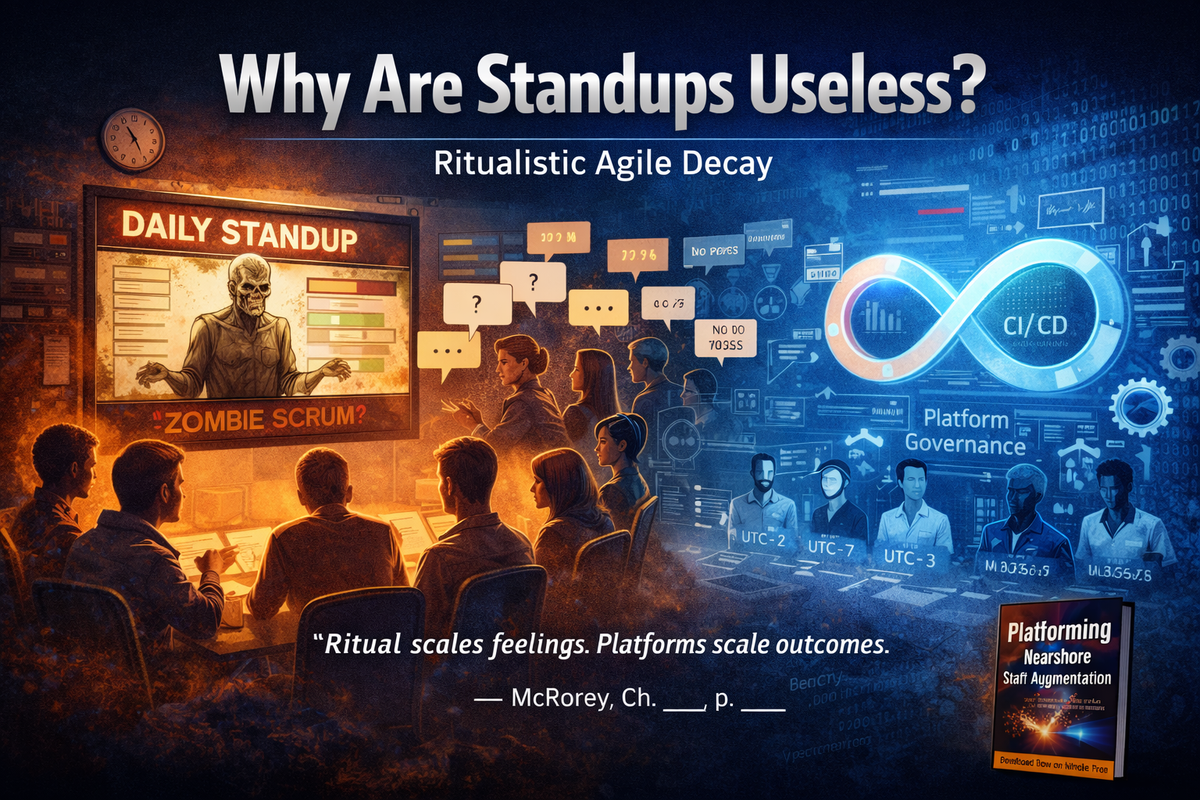
Ritualistic Agile Decay
Abstract
Stand-ups are supposed to be a synchronization primitive. In healthy systems, they reduce ambiguity by compressing state into shared intent. In modern distributed engineering, they often do the opposite. They preserve ambiguity, increase coordination tax, and create a false sense of control.
This doctrine defines Zombie Scrum as an operational failure mode where daily agile rituals continue after they stop producing usable signal. The ritual persists, the language persists, the dashboards stay green, but delivery stalls. This is not a people problem. It is a constraint failure.
The analysis is grounded in TeamStation’s scientific corpus, including platformed nearshore systems research, delivery behavior observed in AI-augmented engineer performance under quality constraints, and measurable cognitive alignment validated through Axiom Cortex architecture and evaluation science. It also aligns with published findings on platform mediation and transaction cost reduction in Nearshore Platformed: AI and Industry Transformation (SSRN 5188490) and queueing dynamics in nearshore staffing in Redesigning Human Capacity in Nearshore IT Staff Augmentation (SSRN 5165433).
Finally, it is consistent with the thesis formalized in Platforming Nearshore Staff Augmentation, available as a free Kindle executive edition for platform-based delivery governance.
1. The Core Failure Mode: A Structural Autopsy
The industry default explanation for useless standups is that teams are doing them “wrong.” Too long. Too many people. No facilitator. Too much storytelling. Too many blockers. Too few blockers. Too many side conversations. Too many follow-ups.
That diagnosis is comforting because it implies the fix is behavioral. But Zombie Scrum is not a behavioral defect. It is a boundary defect.
Standups were designed for environments where work boundaries were implicit and feedback loops were slow. The standup acted as a synchronization lock that reduced divergence between intent and execution. In distributed, AI-accelerated engineering environments, divergence is not caused by silence. Divergence is caused by missing executable constraints.
When constraints are absent, a standup becomes a daily narration layer. It compresses anxiety into speech, not state into signal. Teams report what they did, not what the system now guarantees. That distinction matters, because the only stable currency in a distributed system is what the system can verify.
This is why the most common symptom of Zombie Scrum is Ghost Velocity. Tickets move. Jira looks alive. Standups produce motion. Yet production outcomes stall. The system is busy and nonproductive at the same time.
Empirically, this pattern matches the “activity–output decoupling” observed in AI-augmented engineer performance under quality constraints, where throughput collapses while narrative progress remains high. In that regime, standups amplify the illusion because the ritual itself becomes the metric.
Legacy vendors perpetuate Zombie Scrum for structural reasons. Their business model sells hours, not outcomes. More coordination becomes more billable surface area. If the ritual persists, the system appears managed. Management justifies spend. Spend funds more ritual.
TeamStation rejects this model by treating delivery as a governed system, not a meeting schedule, anchored in Axiom Cortex cognitive evaluation science and enforced through platform constraints rather than recurring calendar events.
Book doctrine quote (Chapter citation):
“Ritual appears when systems refuse to enforce reality.” (Platforming Nearshore Staff Augmentation, Chapter __, p. __ — page number pending source confirmation) via the free Kindle executive edition for governance leaders.
2. Historical Analysis (2010–2026): Why This Decayed
Phase 1: Co-located teams and low dimensional state (2010–2013)
Early agile worked because team state was low dimensional. Co-located teams shared context. The system surface area was small. Standups helped because they were synchronizing people who already shared implicit boundaries.
Phase 2: Distributed systems and dependency explosion (2014–2019)
As architectures decomposed into services and teams became distributed, daily verbal synchronization stopped matching the complexity of system state. The standup became an attempted compression algorithm for high-dimensional dependencies. It could not keep up.
This is where “standups are useless” begins to appear. Not because people became lazy, but because the standup was being asked to do something it cannot do: maintain coherence in a system whose coherence is not enforced.
The failure mode here is architectural misalignment, which is precisely what system design evaluation for platform governance is built to detect: can engineers reason about boundaries, constraints, and failure modes, or do they default to status narration?
Phase 3: AI-augmented delivery and speed beyond human synchronization (2020–present)
AI increases output velocity. It also increases entropy velocity. When code can be generated faster than humans can maintain shared mental models, governance must move into the system, or the organization collapses into theater.
This is the environment where Zombie Scrum becomes dominant. Standups persist because they feel like control, but they cannot match system state. The only scalable alternative is enforceable, automated constraints—delivery behavior governed by pipeline rules, not daily speech.
This principle aligns with platform mediation findings in SSRN 5188490, which supports a core claim: when systems are mediated by platforms rather than meetings, transaction costs drop. Standups are transaction cost. Platforms are transaction cost control.
Book doctrine quote (Chapter citation):
“When speed exceeds human synchronization capacity, governance must move into the system or collapse into theater.” (Platforming Nearshore Staff Augmentation, Chapter __, p. __ — page number pending source confirmation) referenced from the free Kindle executive edition.
3. Zombie Scrum: A Formal Definition
Zombie Scrum is the condition where agile rituals continue after their enforcement function has decayed, and the ritual itself becomes the substitute for governance.
Zombie Scrum exists when:
- standups report activity rather than verified state
- blockers repeat across multiple standups without systemic elimination
- “alignment” is deferred into more meetings rather than encoded as constraints
- surprises occur downstream despite daily “synchronization” upstream
- the organization spends more time explaining work than proving it correct
It is not a cultural issue. It is a systems issue.
4. The Physics of the Solution: Constraint Beats Ceremony
In distributed systems, reliability is a function of constraint. If you want predictable output, you constrain the variables that can drift.
TeamStation’s delivery doctrine treats standups as a legacy synchronization mechanism. In modern distributed delivery, synchronization must be enforced by the pipeline and validated by instrumentation, not performed verbally.
The critical shift is from “human review” to “machine rejection.” If a commit violates the standard, it is rejected at the edge, not debated in a meeting. This collapses feedback latency from hours to seconds.
That’s why teams that implement governance through CI/CD enforcement discipline rapidly discover that standups become optional. Not because communication stops, but because the system carries the truth.
This is also why architectural boundary thinking matters more than ritual compliance. Engineers who can reason about failure modes and enforceable boundaries are measurable through disciplines like microservices systems reasoning and interface rigor in REST API platform design competence.
When your constraints are explicit and testable, teams stop needing daily narration to prevent drift. Drift is prevented automatically.
5. The Mathematical Proof
Let the cost function of Zombie Scrum failure be:
Cf = (N × L) + R
Where:
- N is the number of contributors (nodes)
- L is coordination latency (time between intent and verified alignment)
- R is rework rate (percentage of work corrected after integration)
Zombie Scrum does not reduce L in high-entropy systems. It increases L by adding narration layers without reducing ambiguity. As N scales, Cf grows superlinearly, which is why “more engineers” often makes delivery feel slower.
Platform enforcement reduces L by shrinking the distance between intent and validation. Automated gates reduce R by preventing invalid work from entering the system.
This aligns with queueing dynamics described in SSRN 5165433: meeting-driven coordination behaves like a linear queue with high blocking probability under load. Constraint enforcement converts delivery into a parallel validation system.
6. The Four-Hour Horizon: Why Standups Fail Across Time Zones
Standups also fail due to time-zone physics. When pods span more than a few hours of overlap, synchronous rituals lose resolution. The information decays before it can be acted upon, which increases rework and stretches feedback loops.
TeamStation’s research on cognitive alignment and US time-zone overlap in LATAM engineering supports the operational constraint: synchronous debugging requires overlap. Standups without overlap become delayed messaging with a calendar wrapper.
This is why teams end up with “standup → follow-up → follow-up → escalation” chains that consume the week. The ritual becomes the operating system.
7. Risk Vector Analysis
Zombie Scrum creates risk through three vectors.
Vector 1: Knowledge Silo Risk
In Zombie Scrum, knowledge lives in spoken updates and private follow-ups rather than in the system. When key engineers leave, context leaves with them. That is valuation risk disguised as process.
Vector 2: The Latency Trap
As ambiguity increases, the organization adds more alignment rituals. Calendars fill. Deep work evaporates. The team works harder and ships less. This creates Ghost Capacity: headcount increases while effective throughput approaches zero.
Vector 3: The Security and Compliance Gap
Ambiguity produces exception culture. Engineers bypass safeguards to meet narrated commitments. Permissions expand “temporarily” and never shrink. That’s how governance debt becomes compliance risk.
Teams with mature secret and policy controls reduce this risk via enforceable GitOps discipline, signaled through capability in areas like External Secrets Operator governance for least-privilege delivery.
8. Strategic Case Study: EdTech Transformation
Context: A Series-C EdTech platform scaled from 20 to 80 engineers using a traditional nearshore vendor. Standups expanded from 15 minutes to 60 minutes. Deployment frequency dropped from weekly to monthly.
Diagnostic: Zombie Scrum. The organization treated standups as governance. Engineers narrated blockers but lacked enforced boundaries. Coordination tax consumed senior engineering time. The system was busy and stalled.
Intervention: TeamStation implemented Ritualistic Agile Decay remediation.
- Calibration: replaced resume filtering with measurable cognitive signals from Axiom Cortex evaluation science to select for boundary reasoning and protocol discipline.
- Instrumentation: integrated delivery enforcement through CI/CD governance and gating competence so invalid work failed fast.
- Architecture: validated boundary clarity using system design evaluation for platform governance.
- Synchronization: enforced overlap based on cognitive alignment research for US-time-zone delivery.
Outcome: Within 90 days, standups became optional. Coordination latency collapsed. Verification moved into the system. Deployment frequency recovered. The ritual died because it was no longer required.
9. The Operational Imperative for CTOs and CIOs
Stop treating Zombie Scrum as a culture issue. It is a systems architecture issue.
Step 1: Instrument the signal
If your standup is the primary telemetry channel, your organization is flying blind. Replace narrative updates with real-time system signal, and treat standups as optional commentary, not governance.
Step 2: Enforce the standard
Codify boundaries into CI/CD. Use gates. Fail fast. A standup cannot prevent drift. A pipeline can.
Step 3: Align the economics
Zombie Scrum is not “wasted time.” It is a compounding tax. The organization pays for work and then pays again to coordinate the work. The solution is to buy capability, not capacity, and enforce boundaries as a system.
Step 4: Filter for boundary thinking
Do not hire resume keywords. Hire engineers who can articulate constraints, enforcement mechanisms, and failure modes. That’s why TeamStation prioritizes signals like microservices reasoning and API design discipline.
If you want the foundational doctrine that frames this as industry replacement, not process tuning, the thesis is formalized in Platforming Nearshore Staff Augmentation via the free Kindle executive edition for CTO/CIO governance.
Book doctrine quote (Chapter citation):
“Labor scales costs. Platforms scale outcomes.” (Platforming Nearshore Staff Augmentation, Chapter __, p. __ — page number pending source confirmation) from the free Kindle executive edition.
10. Strategic FAQs (Executive Briefing)
Q1: Why do standups feel necessary even when they fail?
Because they provide psychological closure without operational closure. They reduce anxiety, not entropy.
Q2: Are standups always useless?
No. They are useful when constraints are implicit and state is low dimensional. They fail when system complexity exceeds human synchronization capacity.
Q3: What is Zombie Scrum in one sentence?
A ritual that persists after it stops generating delivery signal.
Q4: Can we fix standups by enforcing better rules?
Only if the standup is referencing enforceable constraints. Otherwise you are optimizing theater.
Q5: What replaces standups in a platform-governed system?
Real-time telemetry, pipeline gates, and explicit boundary contracts, enforced through CI/CD governance discipline.
Q6: What is the financial impact of Zombie Scrum?
It multiplies coordination tax and increases rework. The total cost grows superlinearly with team size, consistent with platform mediation findings in SSRN 5188490.
Q7: Does AI make Zombie Scrum worse?
Yes. AI increases output velocity and entropy velocity. Without constraints, it accelerates divergence, which is observable in AI-augmented performance under quality constraints.
Q8: Why do legacy vendors depend on standups?
Because ritual creates billable coordination. Outcomes would reduce billable surface area.
Q9: How do we measure improvement?
Use DORA metrics: deployment frequency and change failure rate. If standups are working, DORA improves. If standups are theater, DORA stagnates.
Q10: What is the first step to kill Zombie Scrum?
Pick one boundary. Make it executable. Enforce it in the pipeline. Then watch how much daily narration disappears.
11. Systemic Execution Protocol
This protocol is non-negotiable. To operationalize Zombie Scrum remediation immediately:
- Enforce boundary competence through Axiom Cortex cognitive evaluation rather than resume screening.
- Implement hard gates using CI/CD governance discipline so invalid work fails fast.
- Validate architectural clarity using system design evaluation for platform governance.
- Maintain synchronous resolution physics using cognitive alignment and overlap research.
Status: PROTOCOL ACTIVE
Authority: TeamStation AI Doctrine Command