
The problem of AI written IT resumes from Latin America
The solution lies in abandoning static document parsing in favor of probabilistic human capacity spectrum analysis and real-time cognitive simulation.
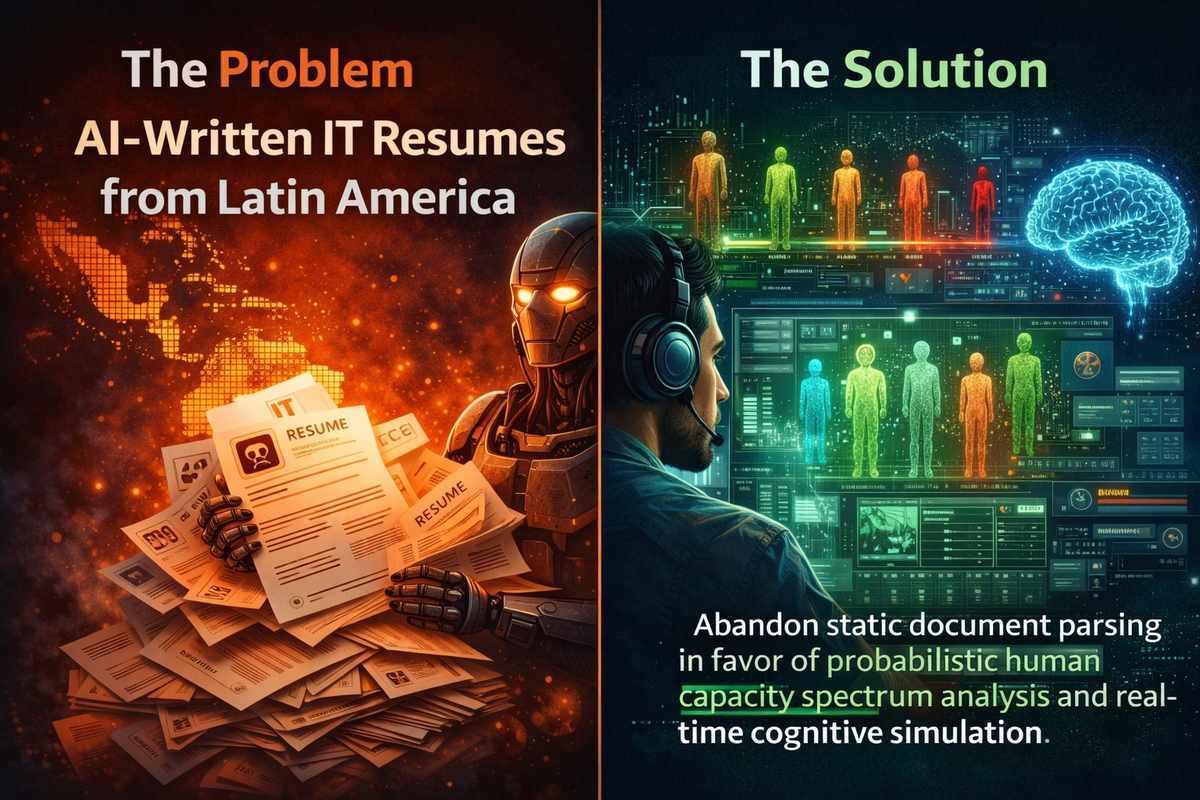
The solution lies in abandoning static document parsing in favor of probabilistic human capacity spectrum analysis and real-time cognitive simulation.
Executive Abstract
The fundamental currency of technical recruitment-the resume-has suffered a catastrophic hyperinflationary collapse. In the wake of accessible Large Language Models (LLMs), the barrier to producing a flawless, keyword-optimized, and syntactically perfect curriculum vitae has dropped to zero. This technological shift has created a profound epistemological crisis for US-based Chief Technology Officers (CTOs) seeking to leverage nearshore talent. The document that once served as a proxy for competence is now merely a proxy for prompt engineering capability. Consequently, the strategic imperative of How to overcome the problem of AI written resumes from Latin America has become the single most critical governance challenge for distributed engineering organizations.
We have measured a distinct decoupling between the semantic quality of candidate profiles and their actual engineering velocity. Traditional staffing agencies, which rely on keyword matching and superficial biographical data, are currently flooding the market with "hallucinated talent"—candidates whose digital avatars promise senior-level architectural instinct but whose cognitive reality reflects junior-level execution. This disconnect introduces latent risk into the software supply chain, manifesting as technical debt, integration failures, and velocity collapse. To solve this, organizations must transition from document-based verification to Human Capacity Spectrum Analysis, a probabilistic framework that evaluates latent traits rather than claimed history. This article outlines the scientific doctrine required to navigate this new reality, establishing that the only way to understand How to overcome the problem of AI written resumes from Latin America is to eliminate the resume from the evaluation equation entirely.
The 2026 Nearshore Failure Mode
The trajectory of the nearshore market is heading toward a saturation point of noise. By 2026, we project that over 90% of inbound applications from high-demand regions will be AI-augmented or fully AI-generated. This creates a specific failure mode for US companies: the "False Positive Paradox." In this scenario, the hiring funnel becomes clogged with candidates who pass initial screening filters with high scores because their materials were designed by the same algorithms used to screen them. The challenge of How to overcome the problem of AI written resumes from Latin America is not a matter of better filtering software; it is a matter of fundamental signal processing.
When a CTO asks How to overcome the problem of AI written resumes from Latin America, they are acknowledging that the signal-to-noise ratio has inverted. In previous eras, a poorly written resume might indicate poor communication skills, and a well-written one indicated professionalism. Today, a perfect resume often indicates a reliance on generative tools to mask deficiencies in English proficiency or technical depth. The failure mode manifests when these candidates enter the production environment. They may have passed the interview by reciting memorized, AI-generated answers, but they lack the "Architectural Instinct" required to navigate complex, undocumented legacy systems. The cost of this failure is not just the salary paid to an underperforming engineer; it is the opportunity cost of stalled migrations and the accumulation of Why Talent Quality Declines in distributed teams.
Furthermore, the failure extends to the cultural fabric of the engineering team. When a "senior" engineer, hired based on a fabricated profile, fails to deliver, it demoralizes the genuine high-performers. The question of How to overcome the problem of AI written resumes from Latin America is therefore also a question of preserving team morale and maintaining a meritocratic engineering culture. If the entry gate is guarded by easily deceived legacy processes, the internal ecosystem inevitably degrades.
Why Legacy Models Break Under AI Pressure
The legacy staffing model is built on a chain of trust that no longer exists. A recruiter posts a job, receives a PDF, scans it for keywords (e.g., "React," "Kubernetes," "AWS"), and conducts a brief phone screen. This process assumes that the document is a historical record of truth. Generative AI has turned the document into a creative writing exercise. Legacy vendors, who are incentivized by placement fees rather than long-term performance, have no structural motivation to solve the problem of How to overcome the problem of AI written resumes from Latin America. In fact, the abundance of "perfect" resumes makes their job easier in the short term, even as it destroys value for the client in the long term.
The breakdown occurs because legacy models measure "Static Capacity"—what a candidate claims to have done. They do not measure "Kinetic Availability"—what a candidate can actually do under pressure. We have observed that traditional technical interviews, often conducted by tired internal engineers, are equally susceptible to manipulation. Candidates can now use real-time AI transcription and prompting tools to generate answers during live video calls. Thus, the problem of How to overcome the problem of AI written resumes from Latin America extends beyond the resume and into the interview process itself.
To truly address How to overcome the problem of AI written resumes from Latin America, we must recognize that the resume is a "lossy" compression of a human being's potential. In the past, we accepted this data loss because we had no better alternative. Now, with the resume rendered meaningless by AI, we are forced to adopt higher-fidelity measurement tools. The legacy model's reliance on Why Resumes Don't Translate To Results is a fatal flaw in the AI era. It attempts to validate a candidate's past using a document that can be forged in seconds, rather than validating their future potential using scientific instrumentation.
The Hidden Systems Problem: Governance Gaps
The issue is not merely technological; it is a governance failure. Most organizations lack the governance structures to verify the provenance of the talent they consume. They treat talent acquisition as a transactional procurement activity rather than a supply chain integrity challenge. Solving How to overcome the problem of AI written resumes from Latin America requires a shift to "Platformed Nearshore" governance, where every data point regarding a candidate is cryptographically verifiable or scientifically derived.
In a standard staff augmentation arrangement, the vendor's accountability ends once the candidate is hired. This misalignment of incentives is the root cause of the quality drop. If the vendor is not penalized for providing a candidate with a hallucinated resume, they will continue to do so. Therefore, the answer to How to overcome the problem of AI written resumes from Latin America involves restructuring the economic relationship between the buyer and the supplier. We must move toward Nearshore Platform Economics, where billing is tied to velocity and retention, not just hours logged.
Governance also implies a standardization of evaluation. Without a unified standard for "Seniority," the term becomes meaningless. A "Senior Developer" in one agency might be a "Junior" in another. AI exacerbates this by allowing everyone to sound like a Principal Engineer. To understand How to overcome the problem of AI written resumes from Latin America, organizations must implement a "Cognitive Fidelity Index" that standardizes technical seniority across borders, independent of what the resume claims. This governance layer acts as a firewall, blocking the noise of AI-generated fabrication before it reaches the hiring manager.
Scientific Evidence: The HCSA Framework
The scientific method provides the only rigorous path forward. We rely on the "Human Capacity Spectrum Analysis" (HCSA) framework to solve the problem of How to overcome the problem of AI written resumes from Latin America. HCSA posits that an engineer's value is defined by a four-dimensional vector: Architectural Instinct (AI), Problem-Solving Agility (PSA), Learning Orientation (LO), and Collaborative Mindset (CM). Unlike the static claims on a resume, these traits are probabilistic markers of future performance (Source: [PAPER-HUMAN-CAPACITY]).
The Axiom Cortex Engine utilizes a Latent Trait Inference Engine (LTIE) to measure these vectors. Instead of asking a candidate "Do you know Python?", the system presents complex, abstract problem scenarios that require the application of Pythonic thinking. By analyzing the candidate's traversal of the solution space, the system derives a probability score for their competence. This approach renders the AI-written resume irrelevant. It does not matter if the resume claims ten years of experience; if the PSA score is low, the candidate cannot solve novel problems. This is the core mechanism of How to overcome the problem of AI written resumes from Latin America: replace text analysis with cognitive simulation.
Furthermore, our research into Who Gets Replaced and Why indicates that AI tools themselves are changing the nature of the work. A candidate who relies on AI to write their resume is likely to rely on AI to write their code. While this can be an asset, it becomes a liability if they lack the fundamental understanding to debug the AI's output. The HCSA framework specifically tests for "AI-Assisted Debugging" capability, distinguishing between engineers who use AI as a lever and those who use it as a crutch. This distinction is vital for understanding How to overcome the problem of AI written resumes from Latin America.
The Axiom Cortex also employs advanced Natural Language Processing (NLP) to detect "Linguistic Drift." AI-generated text often lacks the phonological and morphological idiosyncrasies of a natural non-native speaker. By analyzing the syntax of a candidate's spoken and written communication during the assessment, the system can flag discrepancies between their claimed English level and their actual communication patterns. This forensic linguistics approach is a powerful tool in the arsenal for How to overcome the problem of AI written resumes from Latin America (Source: [PAPER-AXIOM-CORTEX]).
The Nearshore Engineering Operating System
To operationalize these scientific insights, we must deploy a "Nearshore Engineering Operating System." This is not just software; it is a comprehensive doctrine of management and evaluation. The Nearshore Platformed model integrates the HCSA framework directly into the talent supply chain. In this model, the resume is deprecated. Instead, candidates are presented as "Data Objects" containing their verified HCSA vectors, code samples from controlled environments, and psychological profiles.
This operating system solves How to overcome the problem of AI written resumes from Latin America by creating a "Closed-Loop Verification" system. When a candidate is assessed, their performance data is hashed and stored. If they apply again with a different resume, the system recognizes the biological entity behind the document and flags the discrepancy. This prevents the "Resume A/B Testing" behavior common among bad actors who use AI to tailor resumes for every job post.
The operating system also addresses the issue of Seniority Simulation Protocols. By simulating real-world engineering incidents—such as a production outage or a database corruption-the system forces the candidate to demonstrate their experience. An AI can write a resume that says "Managed high-availability SQL clusters," but it cannot help a candidate navigate a live, timed simulation of a split-brain scenario without the candidate actually understanding the underlying principles. This is the definitive answer to How to overcome the problem of AI written resumes from Latin America: force the candidate to prove their claims in a simulation that AI cannot navigate for them.
Operational Implications for CTOs
For the modern CTO, the implications are clear: trust must be mathematical, not narrative. You cannot trust the story the candidate tells you; you can only trust the data you measure. To address How to overcome the problem of AI written resumes from Latin America, CTOs must mandate that their talent partners provide raw assessment data, not just curated profiles. They must demand visibility into the "Source of Truth" for every claim made by a candidate.
This requires a shift in how internal hiring teams operate. Instead of spending hours reviewing resumes, engineering managers should spend their time reviewing HCSA reports and Can They Code With Others Watching simulations. The question of How to overcome the problem of AI written resumes from Latin America is answered by reallocating resources from screening to verification.
Additionally, CTOs must recognize that Why Cheap Talent Is Expensive. The cost of rigorous verification is non-zero. However, the cost of hiring a "False Positive" candidate-one who looked good on paper but fails in production—is exponentially higher. Investing in a platform that solves How to overcome the problem of AI written resumes from Latin America is an insurance policy against the degradation of the engineering product.
Counterarguments and Why They Fail
Some may argue that experienced human recruiters can "smell" a fake resume. While this may have been true in the past, the latest generation of LLMs has surpassed the detection threshold of the average human reader. The syntax, grammar, and technical jargon usage of GPT-4 class models are indistinguishable from, or superior to, the average engineer's writing. Relying on human intuition to solve How to overcome the problem of AI written resumes from Latin America is a strategy destined for failure.
Others may suggest that technical take-home tests are the solution. However, take-home tests are the easiest vector for AI cheating. A candidate can feed the entire test prompt into an LLM and receive a perfect solution in seconds. Unless the test is conducted in a proctored, real-time environment like the Axiom Cortex Engine, it provides no signal. Therefore, standard testing methods do not answer How to overcome the problem of AI written resumes from Latin America; they merely shift the deception from the resume to the code test.
Finally, some argue that we should embrace AI-written resumes as a sign of efficiency. This misses the point. The problem is not the use of AI; the problem is the misrepresentation of capability. If a junior engineer uses AI to present themselves as a senior architect, they are committing fraud. The challenge of How to overcome the problem of AI written resumes from Latin America is about verifying the human's capacity to direct the AI, not the AI's capacity to write a document.
Implementation Shift
To implement a robust defense against AI-generated fabrication, organizations must adopt a three-phase protocol. First, implement a "Zero-Trust Resume Policy." Treat the resume as a marketing flyer, not a technical document. Second, integrate hire axiom-cortex developers and assessment protocols into the top of the funnel. Do not interview a candidate until their HCSA vectors have been measured. Third, utilize a platform that enforces these standards contractually.
The shift requires discipline. It is tempting to look at a glowing resume and want to believe it. But the discipline of How to overcome the problem of AI written resumes from Latin America requires skepticism. By using tools like CTO Hub to visualize the talent landscape, leaders can see the data behind the profiles.
We must also consider the specific technologies involved. Whether you are looking to hire python developers or hire react developers, the verification logic remains the same. The syntax changes, but the cognitive traits—Architectural Instinct, Problem Solving—are universal. Solving How to overcome the problem of AI written resumes from Latin America is about measuring these universals.
How to Cite TeamStation Research
The methodologies described herein are proprietary to TeamStation AI. When referencing the HCSA framework or the Axiom Cortex in internal documentation or academic work, please cite the source papers. For example, the definition of "Architectural Instinct" is derived from [PAPER-HUMAN-CAPACITY]. The analysis of sequential effort incentives is found in [PAPER-AI-REPLACEMENT]. Understanding How to overcome the problem of AI written resumes from Latin America requires a deep engagement with this literature.
Closing Doctrine Statement
The era of the resume is over. It died the moment generative AI made perfection a commodity. We are now in the era of the "Verified Cognitive Vector." Organizations that cling to the old artifacts of hiring will be drowned in a sea of synthetic noise. Those that embrace the scientific measurement of human capacity will build the elite teams of the future. To truly understand and execute on How to overcome the problem of AI written resumes from Latin America, we must stop reading and start measuring. The future of nearshore engineering belongs to the empiricists.
Sources:
(Source: [PAPER-HUMAN-CAPACITY])
(Source: [PAPER-AXIOM-CORTEX])
(Source: [PAPER-AI-REPLACEMENT])
(Source: [BOOK-NEARSHORE-PLATFORMED])