
The 2027 Blueprint for Agentic Engineering Team Topologies in Latin America
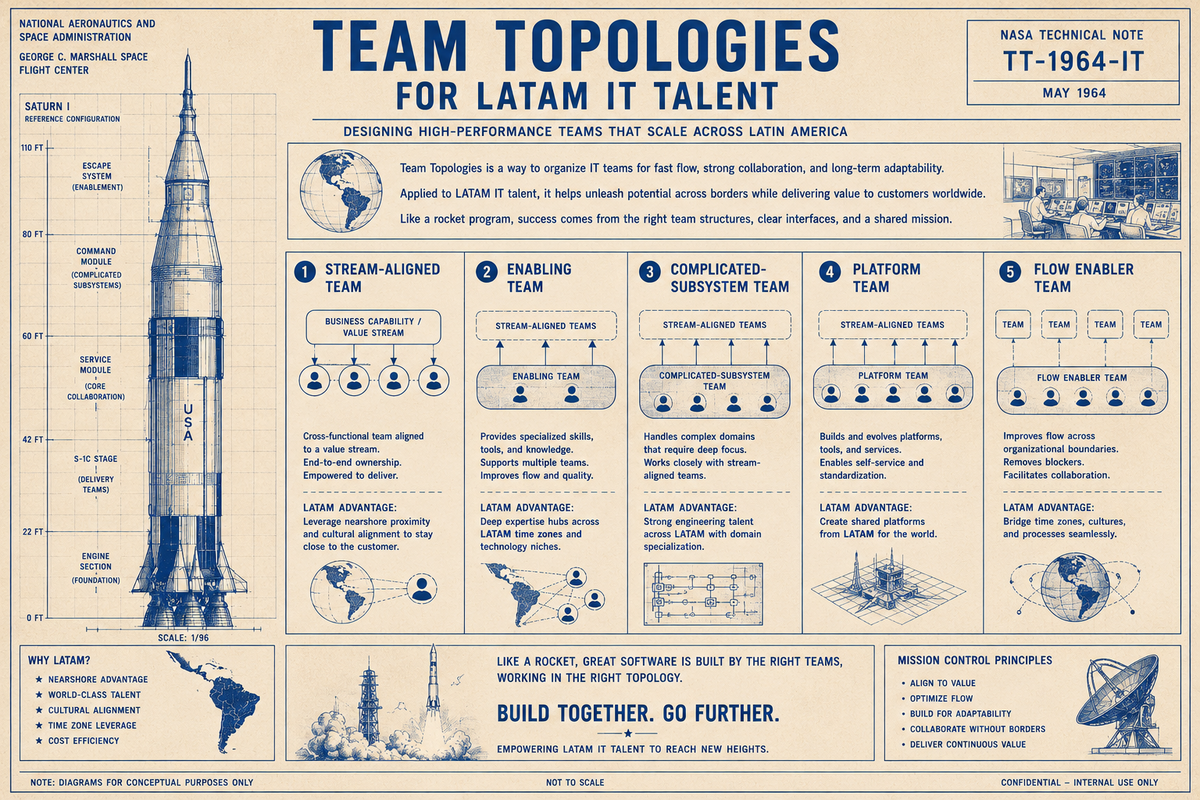
The industry operates under a terminal delusion regarding offshore scaling. Adding headcount does not linearly increase output. It increases the dependency surface area. This is the fundamental reality of distributed systems. We are witnessing the collapse of legacy staff augmentation. The 2027 Blueprint for Agentic Engineering Team Topologies in Latin America replaces opinion with telemetry. It replaces static resumes with probabilistic capacity vectors. We must address the foundational text directly. Nearshore Platformed states clearly that "The quest for exceptional technology talent represents a defining challenge of our time." This is not a marketing platitude. It is a mathematical constraint on enterprise velocity. You cannot build modern platforms with industrial era labor models.
The Utilization Efficiency Paradox and CapEx OpEx Inversion
Traditional nearshore models fail because they optimize for the wrong variable. They optimize for seat utilization. This triggers the Utilization Efficiency Paradox. When utilization approaches one hundred percent, queueing delay explodes to infinity. Busy teams ship nothing. Distributed teams stay busy but deliver less. Why Distributed Teams Stay Busy But Deliver Less details this exact failure mode. The system chokes on its own work in progress. Every new ticket creates a cascading blockage across the network.
Billing for hours rewards slowness. Billing for velocity rewards innovation. (Source: [PAPER-PLATFORM-ECONOMICS]). The CapEx OpEx Inversion occurs when the operational expense of managing cheap talent exceeds the capital expenditure of building a proper platform. The sticker price is a lie. As noted in Nearshore Platformed, "The sticker price isn't the real price." The hidden costs of coordination and rework consume the arbitrage margin. This is the Opportunity Cost of Cheap. Why Cheap Talent Is Expensive explains why low hourly rates guarantee high technical debt. You pay for the code when it is written and you pay for it again when it breaks production.
We see this manifest in the Technical Inflation Index. The cost of maintaining legacy code rises exponentially over time. Every sprint that produces brittle architecture compounds the Technical Debt Interest Rate. You end up fixing the same bug repeatedly. Why Are We Fixing The Same Bug Again is a symptom of systemic failure. The monolith crushes the team. Why Is The Monolith Crushing The Team explains the physics of this collapse. You must migrate to distributed systems to survive. Why Is The Migration Stalled occurs when you lack the cognitive capacity to execute the transition.
Sequential Probability and The Agentic Engineering Reliability Threshold
Teams are not collections of independent workers. They are sequential probability networks. If a pipeline has five stages and each stage has a ninety percent success probability, the total system reliability is fifty nine percent. This is the O-Ring invariant. Multiplicative failure modes govern software delivery. The Agentic Engineering Reliability Threshold dictates that any node falling below a specific cognitive baseline will destroy the output of the entire chain.
The 2027 Blueprint for Agentic Engineering Team Topologies in Latin America demands strict adherence to this math. You cannot insert a low capacity node into a critical integration path. Doing so collapses downstream incentives. Sequential Effort Incentives dictate that automating the middle breaks the chain while automating the end saves cost. (Source: [PAPER-AI-REPLACEMENT]). When upstream variance increases, downstream velocity dies. Why Engineering Velocity Collapses illustrates this phenomenon. We must map the topology explicitly. Team Engineering Topologies provides the framework for modeling these interaction modes. We do not guess where the bottlenecks are. We measure them through telemetry.
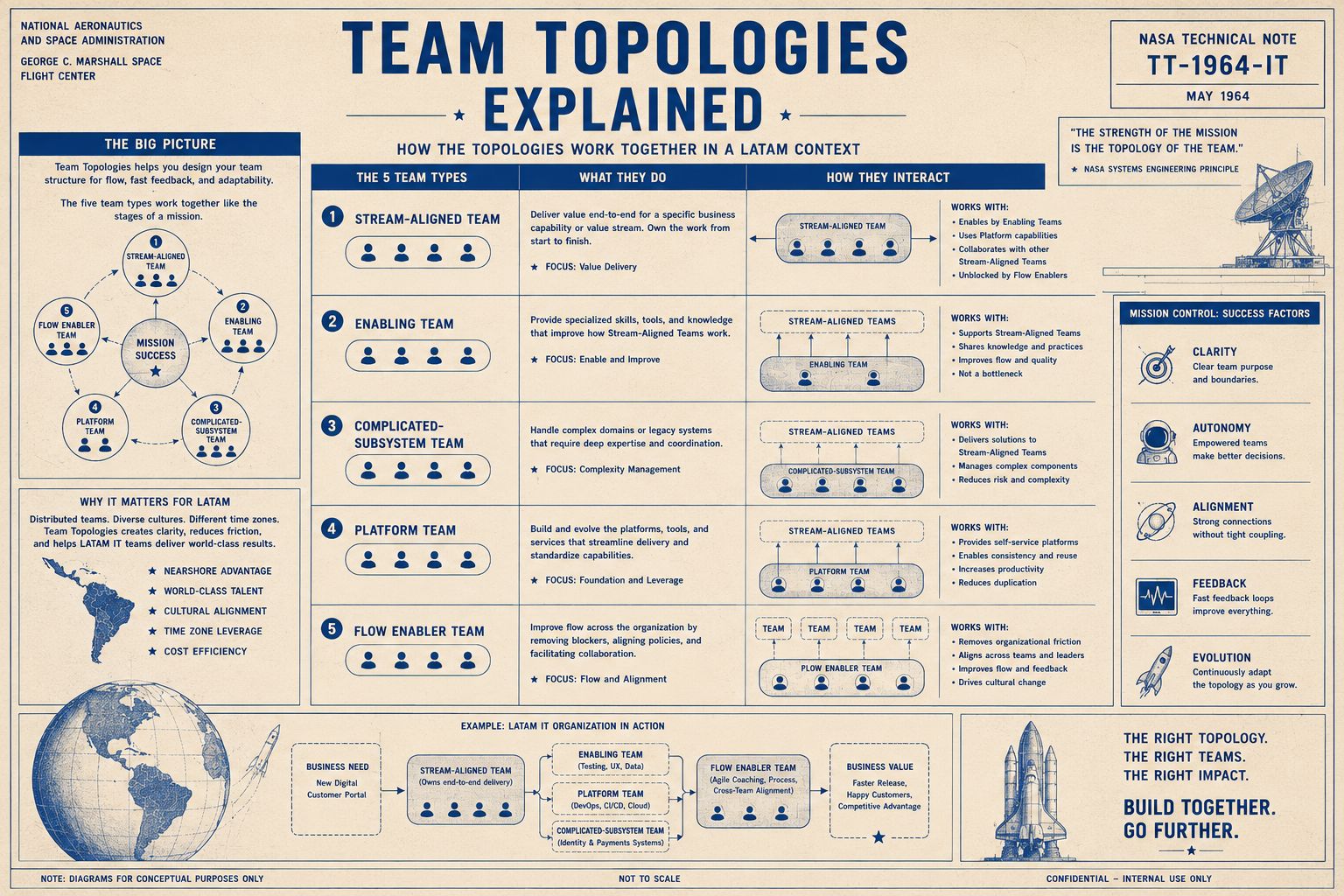
The resume is a dead artifact. It measures past syntax exposure. It cannot predict future system design capability under pressure. We require a fundamentally different instrument. Axiom Cortex is strictly a Neuro-Psychometric Evaluation Engine. It evaluates human talent. It is not a security tool. It is not a firewall. It is not a CI/CD pipeline or a kill switch. It is a pure cognitive measurement system designed to extract the latent traits of software engineers.
Axiom Cortex executes a Self Governing Phasic Micro-Chunking methodology. Phasic Micro-Chunking eliminates interview hallucination and reduces bias. (Source: [PAPER-AXIOM-CORTEX]). It measures Architectural Instinct, Problem Solving Agility, Learning Orientation, and Collaborative Mindset. We use this engine to evaluate specific technical domains with absolute precision. We run the system-design Assessment assessment to measure top down architectural thinking. We deploy the microservices Assessment and event-sourcing Assessment modules to verify distributed systems competence. We do not ask trivia questions. We force the candidate to navigate complex state mutations.
Human Capacity Spectrum Analysis provides the probabilistic framework. HCSA dictates that we hire for vector magnitude, which is Capacity, not just current position, which is Skill. (Source: [PAPER-HUMAN-CAPACITY]). A candidate might know React today. Will they survive the next framework shift. Will They Survive The Next Framework Shift asks this critical question. We measure their Learning Orientation to find out. We evaluate their cognitive fidelity index. Cognitive Fidelity Index defines this metric. We do not care if they can recite documentation. We care if they can whiteboard architecture. Can They Whiteboard Architecture is the true test of capability. Can they code with others watching. Can They Code With Others Watching separates the practitioners from the theorists.
The Coordination Cost Paradox and AI Placement
Where does artificial intelligence belong in a distributed engineering pipeline. The answer is not everywhere. Placing AI deterministically in the middle of a workflow breaks the peer monitoring chain. It destroys the informational link that human engineers rely on. The end of the pipeline has flat incentives. Roles focused on synthetic QA runs or batch data checks are highly automatable. We deploy AI here to finalize the product. The center of the pipeline is structurally protected. Middle roles sit on the steepest part of the incentive gradient. These are your integration and architecture nodes. You must protect the center. AI Placement in Pipelines maps this exact deployment strategy.
The Coordination Cost Paradox dictates that adding more humans to solve a coordination problem exponentially increases the coordination cost. Why Adding Engineers Reduces Productivity proves this. The solution is platformed orchestration. We use the Nearshore IT Co-Pilot to govern the interaction boundaries. We measure the Verification Latency Curve. How long does it take for a developer to know their code broke the build. Why Does The Night Shift Break The Build explores the consequences of high latency. If the feedback loop is slow, the architecture rots. Why Is The Feedback Loop So Slow is the silent killer of engineering velocity.
When fixing AI code costs more than writing it from scratch, you have failed the topology design. When Fixing AI Code Costs More is a direct result of placing generative tools in the hands of low capacity engineers. They accept hallucinations because they lack the Architectural Instinct to detect the flaw. This is why talent quality declines when companies over rely on automation without measurement. Why Talent Quality Declines is a measurable phenomenon. We prevent this by ensuring every human node possesses the required Problem Solving Agility.
Security Architecture and The Sovereignty Tax Analysis
Cognitive measurement is useless without operational security. You cannot deploy elite talent on compromised infrastructure. The Sovereignty Tax Analysis measures the cost of compliance drag across borders. Why Compliance Slows Teams Down shows how legacy governance fails. Compliance Drag reinforces the reality that paper policies do not stop data exfiltration. We do not rely on paper policies. We enforce security through hard architecture.
Every node in the 2027 Blueprint for Agentic Engineering Team Topologies in Latin America operates under strict zero trust protocols. We mandate Single Sign-On (SSO) integrated with a centralized Identity Provider (IdP). We automate provisioning and deprovisioning via SCIM. No source code resides on local machines. We utilize Virtual Desktop Infrastructure (VDI) to isolate the development environment. We enforce Mobile Device Management (MDM) on all endpoints. This is how you write secure code on a laptop in Brazil. Secure Code on a Laptop details this exact configuration.
Governance does not prevent risk. Architecture prevents risk. Why Governance Doesn't Prevent Risk is required reading for any CTO. We must hire security engineering talent capable of building these systems. We utilize hire security-engineering developers to source the talent and security-engineering Assessment to verify their competence. We test their ability to secure APIs using hire api-security developers. We evaluate their penetration testing methodology via hire penetration-testing developers. Security is not a checklist. It is a continuous topological constraint.
Cognitive Arbitrage Across Latin America
The talent exists. The legacy vendor ecosystem simply cannot find it. They rely on opaque sourcing and keyword matching. This creates the Opaqueness Paradox. Legacy nearshore fails due to opacity while Platformed Nearshore succeeds via deterministic AI governance. (Source: [BOOK-NEARSHORE-PLATFORMED]). We execute Cognitive Arbitrage. We identify high capacity vectors in undervalued markets. We bypass the saturated local pools and extract elite capability directly from the source.
We build specific team topologies using regional hubs. We source java developers in argentina developers for core backend stability. We integrate node developers in brazil engineers for high throughput asynchronous services. We leverage python developers in colombia talent for data engineering and machine learning pipelines. We utilize react developers in mexico specialists for frontend architecture. We expand into [[CTO_CHILE_GO