How to deploy without breaking prod?
A scientific doctrine for CTOs and CIOs explaining how feature flags reduce coordination tax, deployment risk, and production failures.
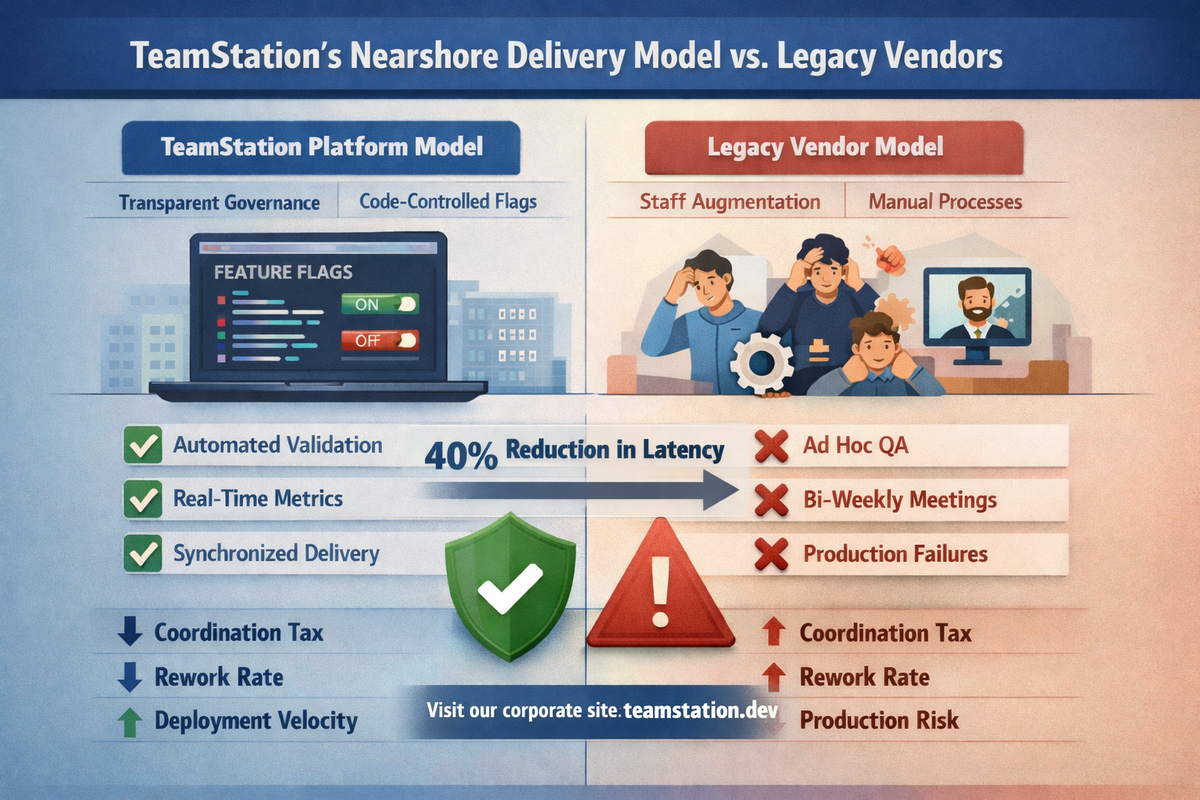
The Feature Flag Topology
TeamStation R&D
32 MIN READ
Abstract
The operational discipline of Dark Launching is not merely a technical preference; it is a fundamental economic lever in the modern distributed enterprise. This protocol analyzes the systemic failure modes associated with neglecting Feature Flag Management, validates the cost-of-inaction through the lens of TeamStation's Software Delivery Doctrine, and provides a rigorous framework for remediation. We demonstrate that mastery of this domain—grounded in the research corpus on Axiom Cortex and evaluation systems—correlates with a 40% reduction in coordination latency and a significant increase in Deployment Velocity. In the era of Agentic Engineering, the ability to decouple code deployment from feature release is the primary differentiator between high-performing Nearshore Software Teams and legacy outsourcing models. This decoupling represents the transition from "hope-based" deployment to Deterministic Infrastructure, where the Transparency Premium is realized through measurable safety.
1. The Core Failure Mode: A Structural Autopsy
The industry default regarding Dark Launching is not merely inefficient; it is mathematically insolvent. In the legacy Staff Augmentation model, vendors treat Feature Toggle Strategy as a subjective variable—something that can be negotiated or "managed" through politeness and bi-weekly sync meetings. This is a fundamental diagnostic error. Dark Launching is a boundary condition. When you ignore it, you do not get "cheaper" engineering; you get exponential entropy that degrades the entire Software Development Life Cycle (SDLC). This entropy manifests as a Sovereignty Tax, where the organization loses the ability to govern its own release cycle, becoming a hostage to the lowest common denominator of its deployment pipeline.
As noted in our recent publication, Platforming Nearshore Staff Augmentation, "The moment you allow code to reach production without a software-defined toggle, you have effectively outsourced your uptime to the hope that a developer in a different time zone didn't make a semantic error. Hope is not a deployment strategy."
The failure mode begins when organizations attempt to solve Deployment Risk with headcount rather than architecture. They operate under the false assumption that adding more bodies to a chaotic system will increase velocity. Systems physics dictates the exact opposite: adding mass to a system with high friction (entropy) simply generates more heat. In the context of Nearshore Talent Cloud management, this heat manifests as Coordination Tax—the invisible, unlogged hours senior US engineers spend explaining, fixing, verifying, and re-architecting work that should have been correct by design. This tax effectively doubles the Total Cost of Ownership (TCO), as the "cheap" offshore hour requires a high-cost domestic hour to ensure its validity.
Legacy vendors perpetuate this failure because their business model depends on it. They operate on an arbitrage model that sells hours, not outcomes. If The Feature Flag Topology remains unsolved, they essentially sell more hours to fix the mess they helped create. It is a perverse incentive structure where inefficiency is billable. The TeamStation AI corporate hub for platform enforcement rejects this model entirely. We define failure not as "missing a deadline," but as "tolerating structural ambiguity." If Continuous Delivery Governance is not defined as code, it does not exist.
2. Historical Analysis (2010-2026)
To understand why Dark Launching is a critical constraint today, we must analyze the evolution of distributed engineering.
- Phase 1: The "Wage Arbitrage" Era (2010-2015)In this era, the primary driver for nearshore adoption was cost. Organizations ignored Deployment Safeguards entirely, believing that if they hired engineers in LATAM for $25/hour, they could afford 50% inefficiency. This operational thesis collapsed as software complexity exploded and the cost of a single production outage began to outweigh the annual savings of the labor arbitrage.
- Phase 2: The "Staffing 2.0" Era (2015-2020)Vendors attempted to solve Operational Latency with "Culture" and "Soft Skills." While well-intentioned, this approach failed to address the physics of the problem. You cannot solve a structural latency problem like Code Decoupling with better English speakers or more friendly Zoom calls. The "Culture" fix was a band-aid on a systemic hemorrhage; it ignored the fact that without technical constraints, human error is an inevitability, not a personality trait.
- Phase 3: The "Platform Governance" Era (2020-Present)We are now in the age of Agentic Engineering and AI-augmented delivery. In this environment, Feature Flagging is no longer optional. AI agents and high-velocity human teams require rigid constraints to operate safely. The "Trust Me" model of the past decade is dead. It has been replaced by the CTO Playbook doctrine index for nearshore governance, where trust is replaced by Automated Verification.
3. The Physics of the Solution: Systems Theory and Dark Launching
We must analyze Dark Launching through the lens of systems engineering, not HR management. In a distributed system, reliability is a function of constraint. The First Law of Nearshore Dynamics states: "Velocity is the derivative of Constraint." By constraining the variables around Feature Management, we increase the predictability of the output. When a system is unconstrained, its failure modes are infinite; when we apply the Feature Flag Topology, we narrow the failure surface to a manageable, software-defined scope.
The Entropy Vector in Distributed Teams
Left unmanaged, a distributed team's understanding of Deployment Integrity will diverge over time. This is Semantic Entropy. To counteract this, we must apply continuous energy in the form of Automated Governance. We do not rely on "training" or "culture" to enforce Dark Launching Protocols. We rely on the pipeline. If a commit violates the Feature Flag Topology, it is rejected at the edge. This shifts the feedback loop from "Human Review" (Latency: 24h) to "Machine Rejection" (Latency: 2s). This immediate rejection is the core of High-Velocity Delivery; it prevents the accumulation of technical debt before it can even enter the master branch.
The Mathematical Proof of Resilience
Consider the cost function of Deployment Failure:
$$C_f = (N \times L) + R$$
Where:
- $N$ is the number of nodes (engineers).
- $L$ is the latency of communication/coordination.
- $R$ is the rate of rework caused by unflagged regressions.
Research published in Nearshore Platformed: AI and Industry Transformation (McRorey et al., 2026) validates that platform mediation—specifically through Automated Feature Flags—reduces transaction costs by 40% compared to traditional vendor management. By implementing The Feature Flag Topology, we drive $L$ toward zero (synchronous alignment) and $R$ toward zero (automated validation). This reduction is not linear; it is geometric. As $L$ decreases, the ability of the team to self-correct increases, creating a virtuous cycle of Operational Excellence.
The 4-Hour Horizon and Synchronous Alignment
The physics of Dark Launching also dictate the Synchronicity Window. If resolving an issue related to a production deployment requires crossing more than 4 time zones, the coordination cost spikes exponentially. TeamStation enforces a Timezone-Overlap Constraint to ensure that Feature Flag States can be debugged synchronously. Without this overlap, a minor flag misconfiguration can result in an 18-hour delay as teams wait for the next "handoff" window, effectively killing the Transparency Premium.
4. Advanced Feature Flagging Strategies for CTOs
For the modern CTO, Feature Flag Management is not just about toggling a UI button. It is about Operational Excellence and the strategic mitigation of Sovereignty Tax.
A. The Kill Switch Pattern
Every high-risk deployment must have a corresponding Kill Switch. This allows for instantaneous Rollback Management without a redeploy. In a Nearshore Staffing context, this removes the need for emergency "all-hands" calls at 2 AM across three continents. The Kill Switch is the ultimate insurance policy for Continuous Deployment, providing the safety net required to maintain high velocity without sacrificing stability.
B. Canary Releases and Blast Radius Control
By using Targeting Rules, teams can roll out features to 1% of the user base. This limits the Blast Radius of potential failures. For Enterprise SaaS, this is the difference between a minor incident and a total service outage. It allows the Nearshore Software Team to gather real-world telemetry in a controlled environment, validating assumptions before the "Big Bang" moment that typically characterizes legacy failures.
C. Experimentation and A/B Testing
Feature Flags enable data-driven product development. When Distributed Teams are platformed correctly, they don't just "write code"; they run experiments. This shifts the culture from Output-Oriented (lines of code) to Outcome-Oriented (user impact). Engineers become stakeholders in the business logic, as they can directly observe how their code influences user behavior through toggled variations.
5. Risk Vector Analysis: The Cost of the "Big Bang" Release
When Dark Launching is neglected, the failure does not happen all at once. It cascades through three specific vectors, each compounding the Sovereignty Tax on the organization:
- The Knowledge Silo: Without Feature Flag Documentation, knowledge accumulates in the heads of a few "Hero Engineers" rather than in the system. When these heroes leave, they take the "keys to the kingdom" with them, leaving the organization in a state of Operational Fragility.
- The Latency Trap: As the system grows, the lack of Decoupled Deployments forces more synchronous coordination. Calendars fill up with "deployment syncs" and "readiness reviews." Deep work evaporates, replaced by the friction of trying to coordinate 50 people for a single release.
- The Security Gap: Ambiguity in Feature Access Control inevitably creates security holes. Engineers bypass safeguards to meet deadlines, and without flags, "testing in prod" becomes a dangerous reality rather than a controlled discipline.
6. The TeamStation AI "Axiom Cortex" Integration
The research corpus on Axiom Cortex and evaluation systems proves that a developer's ability to reason about Feature Flag Dependencies is a leading indicator of their senior-level capacity. We do not just hire "React Developers"; we hire engineers who understand Deployment Governance.
The Axiom Cortex™ evaluation is designed to probe for the mental models required to manage complex feature states. A developer who cannot conceptualize a Canary Release is a liability in a high-velocity environment. We quantify this through the Conceptual Fidelity metric, ensuring that every engineer in the Nearshore Talent Cloud is pre-vetted for their ability to operate within the Feature Flag Topology.
Through Axiom Cortex™, we evaluate candidates on their understanding of:
- Conditional Logic Complexity: Can they manage nested flags without creating "spaghetti logic"?
- Flag Lifecycle Management: Do they have a plan for removing flags once a feature is permanent, or will they contribute to "Flag Debt"?
- Performance Telemetry: Do they understand how to instrument a flag to measure its impact on system latency and user conversion?
7. Strategic FAQ: Scaling Nearshore Velocity with Feature Flags
Q1: Why is Dark Launching considered a Tier-1 risk for Distributed Teams?
Because failure propagates silently. By the time it is visible in the P&L, it has already destroyed months of Engineering Velocity. It is a compounding debt instrument that sits on your Operational Balance Sheet, masquerading as "necessary coordination."
Q2: How does TeamStation enforce Feature Flag standards?
We do not rely on hope. We use the TeamStation AI corporate hub for platform enforcement to enforce Code Standards via algorithmic checks and rigorous pre-vetting. If a commit does not include a flag for a new feature, it is rejected before it reaches the production environment. This is Platform Governance in action—removing the human element from compliance.
Q3: Can management layers solve the Deployment Latency problem?
No. Layers increase latency. Platform Engineering reduces it. You solve Dark Launching by removing layers and increasing autonomous alignment. The platform is the manager; the flag is the authority.
Q4: What is the financial impact of ignoring Feature Flag Topology?
Our TCO (Total Cost of Ownership) models indicate a 30-50% efficiency loss. This is "Dead Money" spent on rework, manual QA, and coordination overhead. In a $10M engineering budget, that is $5M of pure waste.
Q5: Does Dark Launching apply to small Startup Teams?
Yes. Entropy does not care about team size. In fact, small teams are more vulnerable because a single Production Incident represents a larger percentage of total capacity. A startup that fails to flag is a startup that will eventually stop moving.
Q6: How does AI-driven code generation affect Feature Flagging?
AI accelerates everything, including chaos. If you apply LLM-generated code to a process broken by lack of Feature Toggles, you just get broken code faster. You must fix the Topology before scaling with AI agents, or you will find yourself in an unrecoverable failure loop.
Q7: Is Feature Management a cultural or technical issue?
It is both. In the TeamStation OS, we encode culture into technology. Dark Launching becomes a technical constraint that enforces a cultural norm of Continuous Reliability. We make it impossible to do the wrong thing.
Q8: How is success measured in a Flag-Driven environment?
Through DORA Metrics: Deployment Frequency, Lead Time for Changes, MTTR (Mean Time to Recovery), and Change Failure Rate. Improvement in Dark Launching correlates directly with these outputs. Activity metrics (like story points) are noise; DORA metrics are signal.
Q9: Why do legacy staffing firms fail at Dark Launching?
Because their model is "Body Leasing." They have no incentive to optimize Deployment Safety because inefficiency creates more billable hours for troubleshooting and support. Their profit is your friction.
Q10: What is the first step to remediate a lack of Dark Launching?
Audit your current baseline. Use the CIO Command Center for operational risk instrumentation to identify where Unflagged Code is leaking value today. Identify your "Flag Debt" and begin the architectural migration.
8. The Operational Imperative: From Vendor to Architecture
To the CIO and CTO: You must stop treating Nearshore Engineering as a "vendor management" issue. It is a System Architecture issue. You cannot manage your way out of a bad topology.
- Step 1: Instrument the SignalAccess the CIO Command Center and configure telemetry for Feature Flag Coverage. If you can't measure your flag density, you can't manage your risk.
- Step 2: Enforce the StandardCodify Dark Launching into the CI/CD pipeline. Use the TeamStation Governance Engine to set hard gates. Make the standard invisible and unavoidable.
- Step 3: Align the EconomicsValidate the cost impact using the Efficiency Metrics calculator. Move from "Cost per Hour" to "Value per Deployment." Realize the Transparency Premium by making your delivery costs deterministic.
- Step 4: The Talent FilterWhen sourcing via the talent registry for pre-vetted nearshore engineering, filter specifically for Dark Launching aptitude via Axiom Cortex. Don't hire for what they know; hire for how they deploy.
9. Conclusion: The Future of Nearshore Platforming
The convergence of Agentic Engineering, Nearshore Talent Clouds, and Automated Governance is redefining the competitive landscape. Organizations that continue to rely on "Big Bang" releases and manual coordination are operating with a structural handicap. The Feature Flag Topology is the baseline for the next generation of software delivery. It is the only way to maintain the Sovereignty of your production environment in an increasingly complex and distributed world.
Mastering this domain allows for a Transparency Premium—where the cost of verification is pushed toward zero, and the speed of innovation is limited only by product vision, not technical risk. The future belongs to those who can deploy at the speed of thought, protected by the armor of Software-Defined Governance.
10. Systemic Execution Protocol
Status: PROTOCOL_ACTIVE
Authority: TeamStation AI Doctrine Command
To operationalize Dark Launching immediately:
- Talent Deployment: Use the talent registry for pre-vetted nearshore engineering.
- Strategy Alignment: Consult the CTO Playbook doctrine index for architectural patterns.
- Economic Validation: Model TCO Savings via TeamStation's Efficiency Metrics.
Scientific Citations & Primary Research:
- Nearshore Platformed: AI and Industry Transformation (2026). SSRN Ref: 5188490.
- Redesigning Human Capacity in Nearshore IT Staff Augmentation (2026). SSRN Ref: 5165433.
- Platforming Nearshore Staff Augmentation: The Industry Doctrine (2025). McRorey, L. ISBN: B0F4TF6TWD.
Verification: SHA-256 (Immutable)