
How telemetry finds the right mental shape and predicts team performance
Why Teams Fail: Matching Roles, Not Mental Shape
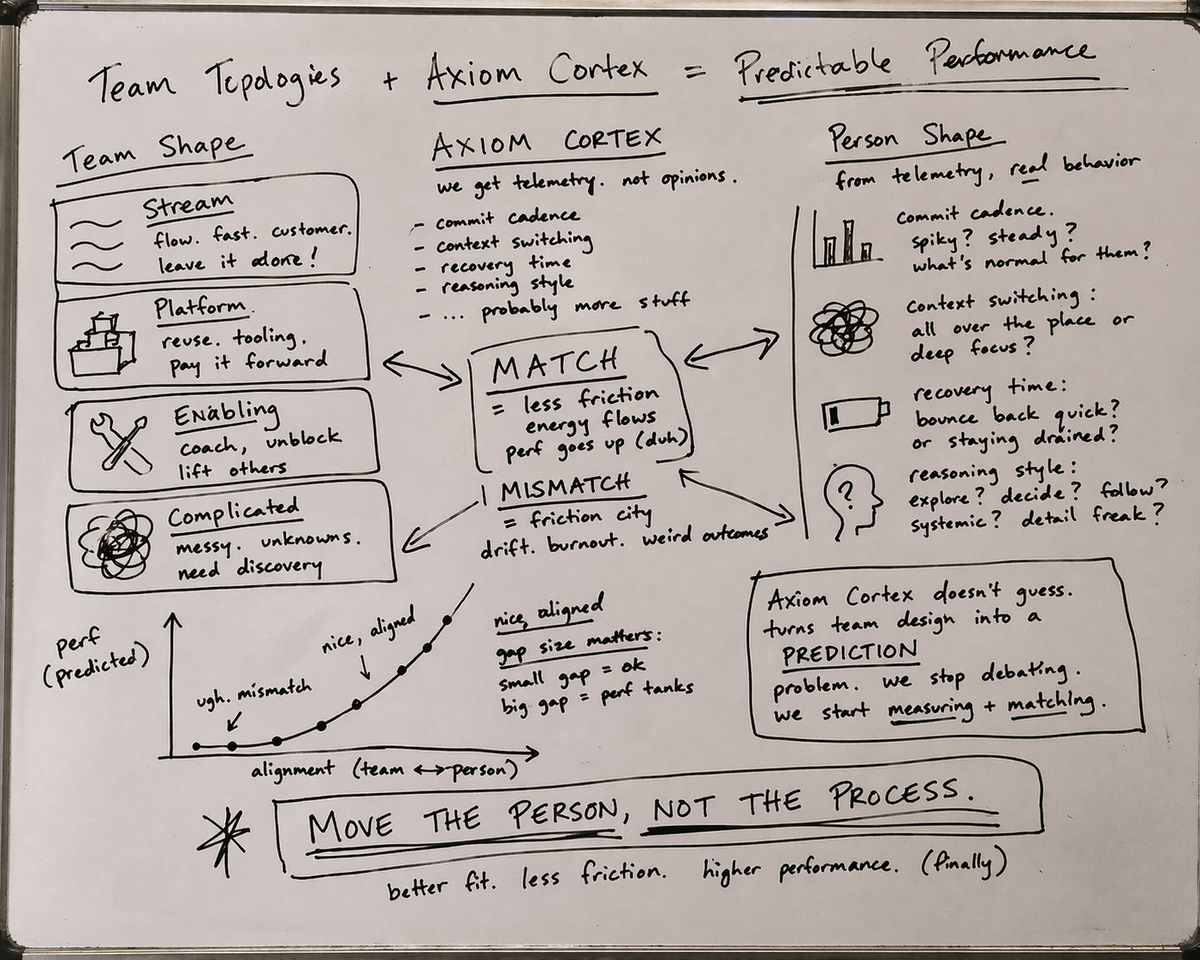
Team Topologies and Axiom Cortex
How the two systems work together
Team Topologies gives us a map for how teams should be shaped, and Axiom Cortex gives us a way to read the people who fill those shapes, so the two systems work best when they run side by side. One system draws the box, and the other system finds the person who actually fits inside the box. Most companies draw the box and then shove anyone into it, and that is why so many teams feel off, feel slow, feel stuck. When you match the shape of the team to the shape of the person, the team starts to move on its own, without being pushed, without being nagged, without being saved.
The four team shapes
Team Topologies says every team fits into one of four types, and each one needs a different kind of mind, a different tolerance for noise, and a different relationship with change. The table below shows what each shape is, what it does, and the kind of person who fits inside it.
How Axiom Cortex reads people
Signals from real work
Axiom Cortex does not use surveys, does not use self-reports, does not use vibes. It reads real telemetry from real work, the kind of work people do every day without thinking about being watched. The signals stack up into a shape, a kind of fingerprint of how a person actually works, not how they say they work, and the shape stays pretty much the same across weeks, even when the topic changes, and that is what makes it useful for matching.
The table below shows the main signals the engine reads, what each one measures, and what it tells us about the person behind the keyboard.
Matching people to team shapes
Once the person shape is read and the team shape is known, the match becomes easy to see on paper. The table below shows the main person shapes, the teams they fit best, the teams they fit worst, and what actually happens when someone lands in the wrong seat.
Why the match predicts performance
Friction is the real cost
Most team pain is not about skill, is not about effort, is not about attitude, it is about friction, and friction comes from putting the wrong shape in the wrong slot. A deep-focus person dropped into a stream-aligned team will burn out from interruptions, will start missing small signals, and will slowly go quiet, and the telemetry shows this drift weeks before the person says anything. A high-switching person dropped into a complicated-subsystem team will feel starved of feedback, will start poking into other teams' work, and will slowly drift into distraction, and the telemetry shows that drift too, in the same quiet way.
Measuring the gap
Axiom Cortex lines up the shape of the person against the shape the team actually needs, not the shape the org chart says the team needs, and the gap between those two shapes is the thing that predicts performance. The table below turns the gap score into a simple action map.
How the two systems divide the work
Team Topologies and Axiom Cortex answer different questions, and neither one can answer the full question alone. The table below shows where each system does the heavy lifting and where they hand off to each other.
The bigger idea
Team design and people design are the same problem, and treating them as two different problems is why most reorgs fail, why most hiring plans miss, and why most performance reviews feel unfair. Team Topologies gives you the grammar of team shapes, Axiom Cortex gives you the grammar of human shapes, and the match between the two is where performance actually lives.
When the shapes line up, the team moves without being pushed, the work flows without being managed, and the output compounds without being forced, and that is what people mean when they say a team has clicked. When the shapes do not line up, no process saves the team, no tool saves the team, no amount of effort saves the team, because the friction is baked into the structure and the structure is invisible until you measure it. The signal is always sitting there in the telemetry, waiting to be read, and the job of the system is to read it early enough to act before the drift turns into damage.