
Engineering The Zero-Trust Kill Switch
Why delayed access revocation is a security failure. Learn how Zero Trust identity, SCIM, and instant offboarding eliminate the blast radius.
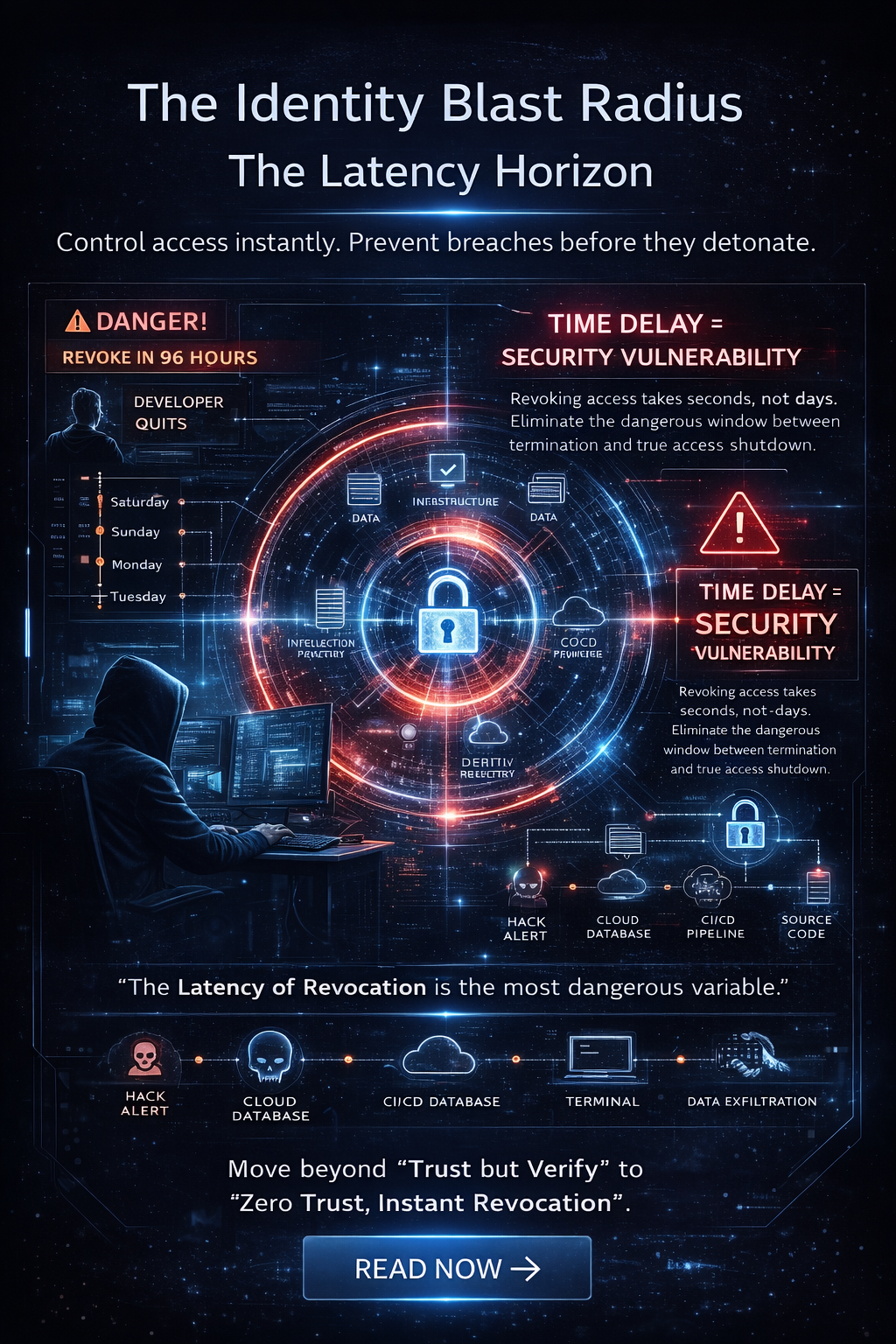
The Identity Blast Radius
The Latency Horizon
Security is not a policy. It is a physics problem. In a distributed engineering environment, the single most dangerous variable is not the sophistication of an external attacker. It is the latency of revocation. We define the Identity Blast Radius as the total volume of infrastructure, data, and intellectual property accessible to a single credential set during the delta between a termination event and the actual technical severance of access.
In traditional nearshore models, this delta is catastrophic. A developer in São Paulo quits on a Friday afternoon. The vendor’s HR department processes the paperwork on Monday. The US-based CTO is notified on Tuesday. For ninety-six hours, a disgruntled or compromised actor retains valid credentials to the CI/CD pipeline, the production database, and the source code repositories. The blast radius is effectively infinite.
This is not a hypothetical edge case. It is the standard operating procedure for the "Vendor Black Box" model described in Nearshore Platformed. The legacy vendor hides the engineer behind a layer of opacity. You do not control the device. You do not control the identity. You merely rent the output. This opacity creates a security vacuum where the "Time Zone Tax" and "Communication Latency" mentioned in the text mutate into security vulnerabilities. A delay in communication is no longer just a missed deadline. It is an open door.
The solution requires a fundamental architectural shift. We must move from "Trust but Verify" to "Zero Trust, Instant Revocation." This demands the implementation of a federated Identity Provider (IdP) architecture that binds every human actor to a central, automated kill switch.
The Dependency Chain of Custody
Modern software delivery is a sequential chain of dependencies. As detailed in (Source: [PAPER-AI-REPLACEMENT]), teams do not operate as isolated units. They function as linked stages where the output of one becomes the input of another. Security inherits this sequential nature. If the identity verification at the start of the chain is weak, every downstream action is poisoned.
We observe a critical failure pattern in unmanaged nearshore teams.
- The Shared Account Fallacy: Vendors save money by sharing seat licenses. Three developers use one Jira login.
- The Local Auth Trap: Developers create local accounts on unmanaged laptops.
- The Shadow IT Sprawl: Teams spin up AWS instances or Trello boards using personal Gmail accounts to bypass friction.
This shatters the Chain of Custody. When a breach occurs, attribution is impossible. You cannot isolate the blast radius because you cannot identify the epicenter.
The TeamStation AI architecture enforces a strict Dependency Chain of Custody. We utilize SCIM (System for Cross-domain Identity Management) to federate identity across the entire toolchain. The IdP (Okta, Azure AD, Google Workspace) becomes the central nervous system. When an engineer is offboarded in the TeamStation platform, the SCIM protocol propagates a "Disable" signal instantly to GitHub, Slack, AWS, and Jira. The chain locks. The blast radius collapses to zero.
The Ephemeral Infrastructure Mandate
Identity is useless if the device remains compromised. A revoked password does not wipe a hard drive sitting on a desk in Guadalajara. This brings us to the concept of Ephemeral Infrastructure.
Data must never reside at rest on an unmanaged endpoint. We enforce the use of Virtual Desktop Infrastructure (VDI) or strictly managed MDM (Mobile Device Management) profiles. The laptop is merely a terminal. It is a window into the secure enclave. If the window is broken, we close the blinds.
This level of rigor requires specific engineering talent. You cannot rely on a generalist IT support technician to architect a Zero-Trust environment. You need specialists.
- hire security-engineering developers: Architects who understand the convergence of IdP and infrastructure.
- hire devops-engineering developers: Engineers who can bake security controls directly into the CI/CD pipeline.
- hire azure developers and hire aws developers: Specialists capable of configuring conditional access policies that block logins from non-compliant devices.
The Insider Threat Horizon
The most dangerous threat often originates inside the perimeter. The "Insider Threat Horizon" is not always malicious. It is often the result of incompetence or a lack of Architectural Instinct.
We reference (Source: [PAPER-AXIOM-CORTEX]) to understand the cognitive dimension of security. A developer with low Architectural Instinct (AI) fails to visualize the system-wide implications of a hard-coded credential. They prioritize convenience over isolation. They open security groups to 0.0.0.0/0 because "it wasn't working."
The Axiom Cortex engine evaluates candidates for this specific trait. We do not just check if they know how to configure a firewall. We assess their Problem-Solving Agility (PSA) and their ability to anticipate failure modes. A security engineer must predict the blast radius before they write the policy.
For organizations building their security core, we provide deep technical evaluation protocols:
- security-engineering Assessment: The Axiom Cortex assessment for security fundamentals.
- vault Assessment: Evaluating proficiency in secrets management.
- external-secrets Assessment: Assessing the ability to decouple credentials from code in Kubernetes environments.
- istio Assessment: Validating knowledge of service mesh security and mTLS.
The JIT Admin Protocol
Permanent administrative access is a relic of the past. It is a liability. No engineer should hold root access 24/7. We advocate for Just-In-Time (JIT) Admin Protocols.
In this model, an engineer requests elevated privileges for a specific task and a specific duration. The request is logged. The access is granted. The timer starts. When the window closes, access is revoked automatically. This limits the temporal blast radius. An attacker who compromises a credential gains standard user access, not the keys to the kingdom.
This requires a sophisticated understanding of Identity Governance and Administration (IGA). It is not a feature you turn on. It is a discipline you hire for.
- hire system-design developers: Engineers who can design permission structures that support JIT without blocking velocity.
- hire data-governance developers: Specialists who ensure that data access logs are immutable and auditable.
The Economic Reality of Zero Trust
Security is often viewed as a cost center. This is a failure of accounting. As argued in (Source: [PAPER-PLATFORM-ECONOMICS]), the cost of a breach far exceeds the cost of prevention. But there is a deeper economic argument.
A secure, federated environment increases velocity. When developers do not have to manage thirty different passwords, they move faster. When access is automated via SCIM, onboarding takes minutes, not days. The "Time-to-Hire" reduction mentioned in Nearshore Platformed extends to "Time-to-Productivity."
Legacy vendors bill for hours. They profit from the inefficiency of manual provisioning. TeamStation AI bills for capacity and velocity. We are incentivized to automate the friction out of the system. The result is a secure environment that is also a high-performance environment.
The Data Residency Mandate
Global teams face a complex web of data sovereignty laws. GDPR in Europe. LGPD in Brazil. CCPA in California. The Identity Blast Radius includes compliance risk. If a developer in Colombia accesses PII (Personally Identifiable Information) stored in a US database without a valid legal framework, the liability is absolute.
We utilize Country Hubs to manage these risks. We understand the local legal frameworks and enforce data residency controls via the IdP.
- hiring in colombia: Understanding the specific compliance landscape for talent in Colombia.
- hiring in brazil: Navigating LGPD requirements for Brazilian engineers.
- hiring in mexico: Managing data flow across the US-Mexico border.
The Technical Implementation: IdP Federation
Let us be specific about the architecture. A robust Nearshore Security posture relies on the integration of three core components: The IdP, the MDM, and the SASE (Secure Access Service Edge).
- The Identity Provider (IdP): This is the source of truth. We recommend Okta or Azure AD. It must support SCIM 2.0. It must enforce MFA (Multi-Factor Authentication) with hardware keys (YubiKey) or biometric verification.
- The Mobile Device Management (MDM): Microsoft Intune or Jamf. The device must be enrolled before it can access the IdP. The IdP checks the device health status (Compliance Flag) before issuing the token.
- The SASE/CASB: Cloud Access Security Broker. This sits between the user and the cloud application. It enforces DLP (Data Loss Prevention) policies. It prevents the download of sensitive files to unmanaged locations.
This stack requires engineers who understand the interplay between identity and infrastructure.
- hire cloudformation developers and hire terraform developers: To deploy the security infrastructure as code.
- hire kubernetes developers: To secure the containerized workloads that the identity protects.
- kubernetes Assessment: To assess the security hardening of K8s clusters.
Conclusion: The Deterministic Security Posture
The era of "trust" is over. We have entered the era of verification. The Identity Blast Radius must be contained through rigorous, deterministic engineering. We do not hope our teams are secure. We engineer them to be secure.
By leveraging the TeamStation AI platform, organizations bypass the opacity of legacy vendors. They gain direct control over the identity lifecycle. They deploy the Axiom Cortex to ensure their engineers possess the cognitive capacity to maintain a secure environment. They utilize the Human Capacity Spectrum Analysis (Source: [PAPER-HUMAN-CAPACITY]) to match the right security talent to the right risk profile.
Security is not an add-on. It is the foundation of the platform.
Strategic Resource Index
For the execution of this doctrine, refer to the following resources:
Core Research & Doctrine:
- TeamStation AI Research: The central repository for TeamStation AI research.
- Human Capacity Spectrum Analysis: Understanding the Human Capacity Spectrum.
- Axiom Cortex Architecture: The architecture of the Axiom Cortex engine.
- Secure Code on a Laptop: Why coding from a coffee shop is a security failure.
- Why Governance Doesn't Prevent Risk: Why traditional governance models fail to prevent risk.
Technical Evaluation (Axiom Cortex):
- security-engineering Assessment: Validate security engineering skills.
- ****: (Implied) Assess network defense capabilities.
- aws Assessment: Assess cloud security configuration.
- azure Assessment: Assess Azure AD and Sentinel proficiency.
Talent Acquisition:
- hire security-engineering developers: Hire vetted security engineers.
- hire devops-engineering developers: Hire DevSecOps professionals.
- hire data-governance developers: Hire compliance and governance experts.
Regional Hubs:
- hiring in argentina: Security talent in Argentina.
- hiring in chile: Advanced engineering talent in Chile.
- hiring in costa-rica: Nearshore security hubs in Costa Rica.
We are building the future of work. It will be distributed. It will be AI-augmented. And it will be secure.