
Distributed Engineering Team Topologies in Latin America
A scientific analysis of distributed engineering team topologies in Latin America using probability, queueing theory & cognitive systems research
Abstract
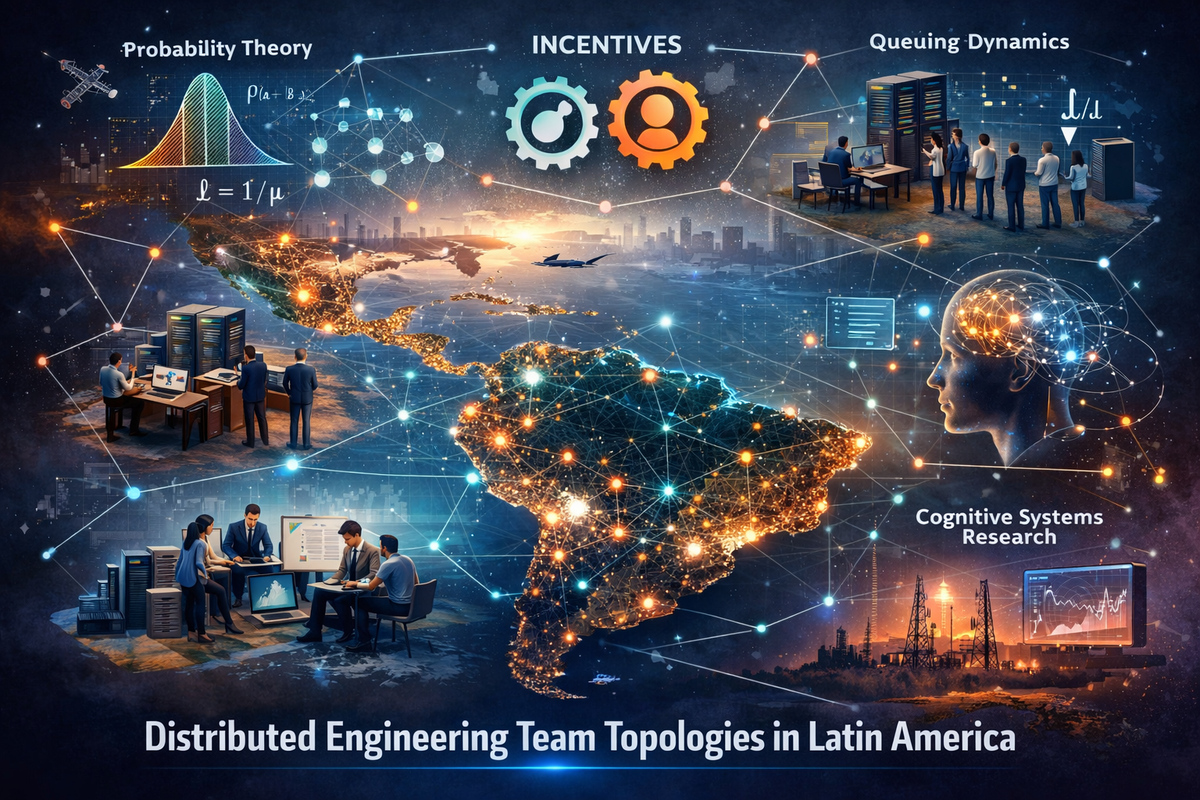
Distributed engineering teams did not fail because of distance. They failed because we modeled them incorrectly. For two decades, global software delivery treated engineers as interchangeable labor units and teams as static hierarchies. That model breaks the moment work becomes probabilistic—moving from certain tasks to high-variance problem solving. Latin America did not expose the flaw; it revealed it by providing a near-perfect control environment of aligned time zones. What follows is not a management essay. It is a systems analysis of distributed engineering team topologies grounded in probability theory, incentive economics, queueing dynamics, and cognitive systems research. The conclusions are uncomfortable. They are also predictive.
The Collapse of the Factory Assumption
Software engineering was never an assembly line. The belief persisted anyway because it was convenient for financial modeling. It allowed executives to talk about utilization, headcount efficiency, and role replacement as if code behaved like steel or fabric. In reality, software work behaves like a stochastic network where variance compounds rather than averages out. We built entire procurement departments around the idea that if you put a requirement in one end, code comes out the other, and the only variable is the cost of the operator.
This fundamental misalignment explains why distributed engineering teams stay busy but deliver less. Activity masks entropy; the system vibrates with energy, heat is generated in the form of endless Slack threads and status updates, but the vector sum of progress remains zero. Motion is frequently mistaken for progress because our management tools are designed to measure "hours logged" rather than "uncertainty reduced."
Latin American teams entered this picture as nearshore capacity, not as probabilistic systems. The pitch was simple: Time zone alignment, cultural proximity, and lower cost. Those are valid logistical inputs, but they are not system controls. Time zone alignment merely reduced communication latency; it did not remove the underlying uncertainty of the work itself. The failure mode remained latent until scale exposed the fragility of treating cognitive workers as factory units.
Teams as Sequential Probability Networks
A distributed engineering team is not a collection of skills; it is a sequence of dependent probability nodes. Each node—each engineer, each approval step, each automated test—emits output whose reliability bounds the effort of the next node. If the output of one step is ambiguous, downstream effort doesn't just slow down; it collapses rationally as engineers refuse to build on a foundation of sand.
In a sequential chain, the probability of successful delivery is multiplicative, not additive. If you have five steps, each ninety percent reliable, your system reliability is not ninety percent. It is fifty-nine percent. A single weak node—a vague product manager or an over-taxed lead—drives the entire chain toward zero. This effect is formalized in the O-Ring invariant. It helps explain the counterintuitive reality of why adding more engineers reduces overall productivity. We add nodes to increase capacity, but we unintentionally increase the exponent of failure, creating more opportunities for the probability chain to snap.
Latin American delivery models historically optimized for volume at the end of the chain—QA, validation, and manual testing. These roles were easier to staff but were structurally replaceable. When you outsource the cognitive core of the topology—the architectural decision-making and domain modeling—you break the probability chain at its most sensitive point.
Incentives Under Distance and Time
Distributed work introduces a second-order variable: Belief. Engineers do not exert effort based solely on compensation; they exert effort based on the perceived probability that their work will matter. This is the unmeasured variable in every staffing contract. If an engineer in São Paulo believes the requirements from New York are unstable or will change in forty-eight hours, the rational economic move is to minimize effort today. They hedge.
When upstream inputs are vague, downstream engineers protect their cognitive energy reserves. This dynamic explains why stand ups are useless. The ritual continues, but the information content drops to zero as it becomes a performance of status rather than a synchronization of state. Latin America amplifies this effect when governance relies on asynchronous artifacts rather than real cognitive signaling. Pull requests without context and tickets without architecture raise coordination costs while lowering incentive margins, eventually leading to a team that is technically present but mentally checked out.
The result is predictable. Velocity collapses after a brief "honeymoon phase" in nearshore staff augmentation. This period is actually just the time it takes for the probability chain to accumulate enough entropy to break. The failure isn't a lack of talent; it's the topology of the incentive structure.
Queueing Theory and the Death of Utilization
Utilization above eighty percent guarantees infinite delay in stochastic systems. This is not opinion; it is Kingman’s limit. Distributed teams often operate at perceived full capacity because idle time looks like waste on a spreadsheet. In reality, idle time is slack, and slack is the only thing that absorbs variance. Without it, queues explode and lead times become unpredictable.
If every engineer is one hundred percent utilized, and a requirement changes—which happens stochastically—the wait time for that change to be processed approaches infinity. The backlog grows not because the team is slow, but because the queue is saturated. This dynamic underpins the mechanics of why software delivery slows down as engineering teams grow. We add people, fill their queues to the brim to "maximize value," and then wonder why the system grinds to a halt. The physics does not change across borders, but the accounting department’s obsession with utilization often ignores these costs.
Cognitive Fidelity as the Missing Variable
Skill matching fails because skills are not the bottleneck; cognitive alignment is. Two engineers with identical resumes can behave differently under uncertainty. One stabilizes the system by resolving ambiguity; the other amplifies noise by asking for more specifications.
Resumes are lossy compression formats. They strip away the context of how an engineer solves problems. This is why resumes fail as predictors, a failure mode examined in why dont strong engineering resumes translate into delivery results. Keywords do not measure mental models. Cognitive fidelity measures the alignment between an engineer’s internal model and the actual system state. When fidelity is high, variance decreases because the engineer can predict the consequences of their code.
In Latin America, the talent pool is deep, but the "seniority" signal is often distorted by consultancy culture. A "Senior Engineer" optimizing for billing hours has a different cognitive model than one optimizing for production stability. If you map the topology wrong, you get a team that nods, agrees, and then builds the wrong thing perfectly—a phenomenon known as why the team is polite but ineffective.
Replacement Kinetics and the AI Illusion
AI does not replace roles symmetrically; it alters incentives asymmetrically. Replacing the end of the chain—like unit test generation—yields clean savings. Replacing the middle—the logic layer—destroys the O-Ring pressure that keeps teams honest. Automation often increases wage pressure upstream because when the safety net of human review rises, the fear of failure drops, leading to a decline in effort unless compensation rises to re-incentivize diligence.
We are seeing an economic inversion where writing the code is becoming cheaper than verifying its correctness. This leads to the dilemma of when does fixing ai code cost more than writing it. Latin American teams feel this acutely because AI is frequently layered on top of already fragile structures. To survive, the nearshore engineer must evolve from a ticket-taker into a system-validator.
Interfaces and Governance
Complexity scales quadratically with the number of interfaces, not linearly with headcount. Distributed teams multiply these interfaces, creating entropy amplifiers. If the software architecture is coupled, the teams must be coupled, or they will deadlock regardless of how many "sync meetings" are scheduled. This is why integration is hell and why the monolith is crushing the team.
Governance frameworks often increase compliance while reducing clarity, optimizing for auditability rather than flow. Effective governance should stabilize probability by reducing output variance. Instead, it often adds drag by requiring "signal" that is actually just noise. This erosion of true signal explains why governance doesn't prevent operational risk; the real risks are hidden in the informal channels and "shadow decisions" made to bypass the drag.
Capital vs. Expense: The Accounting Error
We treat code as an asset and put it on the balance sheet, but code is actually a liability. It carries maintenance, security, and cognitive debt. The only real asset is the runtime behavior that generates revenue. When we treat the production of code as the goal, we incentivize bloat and "more features," which is the fastest way to bankrupt a technical organization. This philosophical error is detailed in is code an expense or an asset. The topology must optimize for value throughput, ensuring every line of code justifies its future maintenance cost.
Conclusion
Teams that survive scale share a specific topology: they protect the middle of the chain, automate the end, and hire nodes based on cognitive fidelity. They understand that deployment is not a ceremony but a frequency used to flush variance out of the system, as seen in how to deploy without breaking prod.
The role of the CTO shifts from staffing to graph design—managing nodes, edges, and latencies. Distributed engineering teams from Latin America did not expose a regional weakness; they exposed a global modeling error. When teams are treated as probabilistic systems, Latin America emerges as a premier region for high-fidelity engineering. When treated as labor arbitrage, it fails on schedule. The math was always there; we simply chose not to look.