
Device Ownership Is a Security Primitive Not a Procurement Detail
Unmanaged nearshore laptops break Zero Trust and expose IPs. Device ownership defines the root of trust, chain of custody, and endpoint controls.
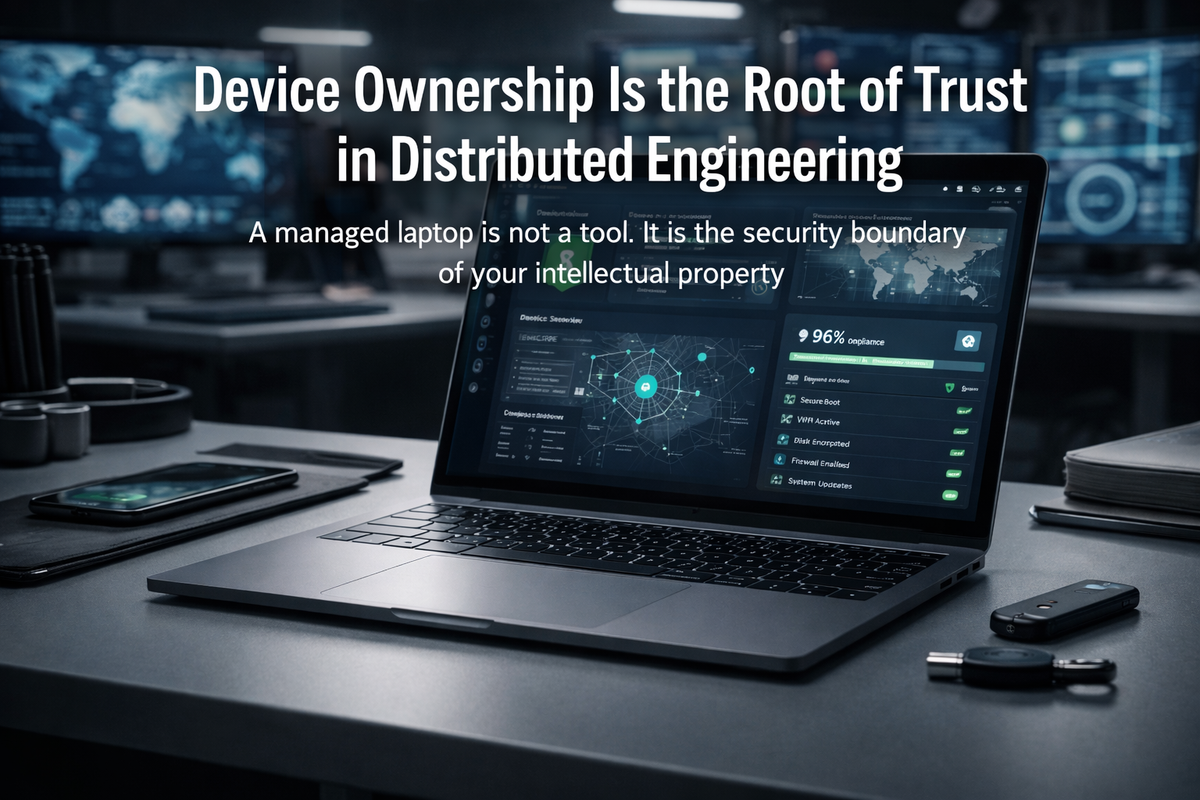
The integrity of a distributed engineering team is mathematically capped by the security posture of its weakest physical endpoint, rendering traditional vendor-supplied hardware models obsolete.
Executive Abstract
In the distributed architecture of modern software engineering, the physical laptop is no longer merely a tool for code entry; it is the biological edge of the corporate network. For decades, the nearshore outsourcing industry has treated hardware provisioning as a logistical afterthought—a line item to be minimized by procurement departments or delegated to staffing vendors who prioritize margin over telemetry. This legacy approach introduces a catastrophic vulnerability into the software supply chain. We assert that Device Ownership Is a Security Primitive Not a Procurement Detail. When a US-based CTO hires a nearshore engineer, the chain of custody regarding that engineer's compute environment determines the security of the entire intellectual property estate. If the device is owned by a third-party staffing agency that lacks advanced Mobile Device Management (MDM) capabilities, or worse, if the engineer is permitted to use a personal device under a "Bring Your Own Device" (BYOD) policy, the client has effectively surrendered control of their source code. Our doctrine establishes that Device Ownership Is a Security Primitive Not a Procurement Detail because the legal and technical ownership of the hardware dictates the root of trust for all subsequent authentication, authorization, and data governance protocols. Without direct, cryptographic control over the endpoint, "Zero Trust" is a theoretical fiction. (Source: [PAPER-PLATFORM-ECONOMICS])
The 2026 Nearshore Failure Mode
By 2026, the primary vector for intellectual property theft in nearshore engagements will not be external state actors hacking firewalls, but rather the compromised endpoints of legitimate remote workers. The failure mode is structural. In the traditional staffing model, a vendor in Latin America hires a developer and provides them with a laptop. To maximize profit, the vendor purchases consumer-grade hardware, installs a basic operating system, and ships it without Endpoint Detection and Response (EDR) or rigorous encryption policies. The client assumes the vendor handles security; the vendor assumes the client handles security via VPN. In this gap of assumed responsibility, the principle that Device Ownership Is a Security Primitive Not a Procurement Detail is ignored, leading to silent data exfiltration. (Source: [BOOK-NEARSHORE-PLATFORMED])
The operational reality of 2026 demands that we view the nearshore developer not as a remote freelancer, but as a node in a secure distributed system. If that node is running on hardware that cannot be remotely wiped, patched, or audited by the client's security operations center (SOC), the node is compromised by default. We have observed that Secure Code on a Laptop is impossible if the underlying hardware is managed by an entity with lower security standards than the IP owner. The failure to recognize that Device Ownership Is a Security Primitive Not a Procurement Detail results in "Shadow IT" at an industrial scale, where proprietary algorithms reside on devices that are shared with family members or infected with malware due to lack of administrative restrictions.
Furthermore, the rise of AI-augmented coding tools accelerates this risk. As developers use local LLMs or proprietary code assistants, sensitive context is cached locally. If the device is not treated as a security primitive, this cached context becomes a gold mine for attackers. The Why Governance Doesn't Prevent Risk phenomenon explains that paper contracts (NDAs) are legally binding but technically impotent. Only the enforcement of Device Ownership Is a Security Primitive Not a Procurement Detail ensures that technical controls match legal expectations.
Why Legacy Models Break
Legacy nearshore models are built on the economics of "Body Leasing." The vendor's incentive is to place a human in a seat as quickly and cheaply as possible. High-end enterprise laptops with TPM 2.0 chips, enrolled in Microsoft Intune or Jamf, represent a significant capital expenditure and a logistical hurdle. Consequently, legacy vendors default to the path of least resistance: unmanaged devices. This breaks the security model because it decouples the worker from the enterprise security architecture. The axiom that Device Ownership Is a Security Primitive Not a Procurement Detail exposes the flaw in treating talent acquisition as separate from infrastructure provisioning. (Source: [PAPER-PLATFORM-ECONOMICS])
When a vendor controls the device procurement but lacks the sophistication to execute proper security engineering, they introduce friction and risk. We see this in the Why Managed Services Don't Reduce Risk paradox: the client pays a premium for "management," but the management does not extend to the silicon level. The legacy model fails to acknowledge that Device Ownership Is a Security Primitive Not a Procurement Detail, treating the laptop as a piece of furniture rather than a cryptographic key. This results in a fragmented security posture where the US team operates inside a fortress, while the nearshore team camps in an open field.
Additionally, the "Staffing Agency" mindset views the laptop as the property of the vendor, to be reclaimed and reused. This creates chain-of-custody nightmares. A laptop used by a developer for a Fintech client might be wiped (imperfectly) and reassigned to a developer for a Healthcare client, leading to cross-contamination of data. If Device Ownership Is a Security Primitive Not a Procurement Detail were the guiding principle, devices would be provisioned, managed, and decommissioned with the same rigor as production servers.
The Hidden Systems Problem (Nearshore Security)
The hidden systems problem in nearshore security is the invisibility of the endpoint. In a physical office, the CTO can walk the floor and see the hardware. In a distributed nearshore team, the hardware is an abstraction. This invisibility breeds complacency. The principle that Device Ownership Is a Security Primitive Not a Procurement Detail forces the visibility of these hidden systems. It demands that the "Procurement Detail"—the purchase order, the shipping logistics, the serial number tracking—be elevated to the status of a "Security Primitive"—a fundamental building block of the defense architecture. (Source: [PAPER-AXIOM-CORTEX])
Security engineering requires a unified control plane. When device ownership is fragmented between the client, the vendor, and potentially the employee, the control plane fractures. Axiom Cortex: security-engineering protocols dictate that a unified control plane is non-negotiable for high-value IP development. By ignoring that Device Ownership Is a Security Primitive Not a Procurement Detail, organizations create blind spots where telemetry goes to die. An unmanaged device does not report patch status, does not report USB insertions, and does not report anomalous process execution.
This problem is exacerbated by the complexity of modern development environments. Developers require local admin rights to run Docker containers, compile code, and configure environments. Granting local admin rights on a device that the client does not own is suicidal. The only way to safely grant necessary privileges is to enforce the rule that Device Ownership Is a Security Primitive Not a Procurement Detail, ensuring that even with admin rights, the device remains subject to the client's ultimate authority via MDM policies that can revoke access instantly.
Scientific Evidence
The necessity of controlling the physical layer is supported by the Human Capacity Spectrum Analysis (HCSA). High-capacity engineers, those with high "Architectural Instinct," require complex, secure environments to function. The Human Capacity Spectrum Analysis framework posits that an engineer's potential is a vector of capability. However, this vector can only be applied if the infrastructure supports it. If a high-capacity engineer is forced to work on a locked-down, laggy VDI (Virtual Desktop Infrastructure) because the client doesn't trust the endpoint, their productivity collapses. Conversely, if they work on an insecure local machine, the IP is at risk. The solution is a secure, high-performance local machine, which requires accepting that Device Ownership Is a Security Primitive Not a Procurement Detail. (Source: [PAPER-HUMAN-CAPACITY])
Further evidence is found in the Sequential Effort Incentives model. Software development is a chain of dependencies. If the security of the endpoint (the first link in the chain) is weak, the integrity of the entire pipeline is compromised. Sequential Effort Incentives theory suggests that downstream actors (QA, DevOps) cannot effectively secure the release if the upstream code was authored in a compromised environment. A breach at the developer's laptop allows an attacker to inject vulnerabilities before the code even reaches the repository. Therefore, Device Ownership Is a Security Primitive Not a Procurement Detail is a prerequisite for trusted sequential production. (Source: [PAPER-AI-REPLACEMENT])
Finally, the Axiom Cortex validation protocols rely on data integrity. We measure engineer performance through digital exhaust. If the device is unmanaged, the data regarding how the engineer works—their commit frequency, their tool usage, their "Learning Orientation"—is lost or unreliable. To accurately assess talent using Axiom Cortex Architecture, we must trust the sensor, which is the laptop. This reinforces the scientific validity of the claim that Device Ownership Is a Security Primitive Not a Procurement Detail; without ownership, we lack the ground truth required for advanced analytics.
The Nearshore Engineering OS
The TeamStation "Nearshore Engineering Operating System" replaces the chaotic "Staffing Agency" model with a deterministic "Platformed" model. In this OS, the provisioning of hardware is automated and strictly governed. We do not ask vendors to "buy a laptop." We deploy a standardized, secure compute node. This node is pre-enrolled in a security fabric that enforces the doctrine that Device Ownership Is a Security Primitive Not a Procurement Detail. The device is not a perk; it is a component of the platform. (Source: [BOOK-NEARSHORE-PLATFORMED])
This Operating System integrates directly with the CTO Hub, providing real-time visibility into the security posture of every deployed engineer. The client can see not just the person, but the machine they are using, its encryption status, and its compliance level. This transparency eliminates the "Hidden Systems Problem." By embedding the hardware lifecycle into the software delivery lifecycle, we operationalize the truth that Device Ownership Is a Security Primitive Not a Procurement Detail.
Furthermore, this OS handles the logistics of asset recovery and sanitization. When an engagement ends, the device is cryptographically wiped. The "Procurement Detail" of shipping is handled by the platform, but the "Security Primitive" of data destruction is handled by the code. This fusion of logistics and security is the hallmark of a platformed approach, proving once again that Device Ownership Is a Security Primitive Not a Procurement Detail.
Operational Implications for CTOs
For the Chief Technology Officer, the implication is immediate: stop treating nearshore hardware as an OpEx line item to be squeezed. Demand that your nearshore partner provides devices that can be enrolled directly into your corporate MDM (Intune, Kandji, Jamf). If the partner refuses, citing cost or complexity, they are rejecting the principle that Device Ownership Is a Security Primitive Not a Procurement Detail. This is a disqualifying event. A CTO must extend their security perimeter to include these remote nodes. (Source: [PAPER-PLATFORM-ECONOMICS])
CTOs must also rethink their VDI strategies. Virtual Desktops are often used as a band-aid for lack of device trust. However, VDI introduces latency that frustrates high-performance engineers, leading to Why Engineering Velocity Collapses. The superior operational model is a Zero Trust Network Access (ZTNA) architecture running on managed, client-owned (or effectively client-controlled) hardware. This aligns performance with security, adhering to the mandate that Device Ownership Is a Security Primitive Not a Procurement Detail.
Additionally, the CTO must audit the "Shadow Procurement" of their vendors. Ask for the serial numbers. Ask for the antivirus logs. If the vendor cannot produce them, they are failing the operational requirement. The realization that Device Ownership Is a Security Primitive Not a Procurement Detail shifts the conversation from "How much is the hourly rate?" to "What is the chain of custody for the compute power?"
Counterarguments (and why they fail)
Counterargument 1: "It is too expensive to ship US laptops to Latin America." Critics argue that import duties and shipping logistics make it prohibitive for US clients to provide hardware, thus invalidating the idea that Device Ownership Is a Security Primitive Not a Procurement Detail. Refutation: This is a false economy. The cost of a single data breach or IP leak vastly outweighs the cost of a MacBook Pro and import taxes. Furthermore, modern platformed vendors (like TeamStation) handle the local procurement of enterprise-grade hardware that meets US standards, ensuring the security primitive is maintained without the logistical nightmare of cross-border shipping. The cost is negligible compared to the risk.
Counterargument 2: "VDI / Citrix solves this without hardware ownership." Many IT directors believe that keeping data in the cloud via VDI negates the need for secure endpoints, challenging the notion that Device Ownership Is a Security Primitive Not a Procurement Detail. Refutation: VDI solves data residency but destroys developer experience (DX). Latency kills flow. High-capacity engineers will bypass VDI to run local builds, creating a shadow workflow on the insecure endpoint. Security that prevents work is security that will be circumvented. True security requires a secure local environment, which brings us back to the necessity of managed hardware.
Counterargument 3: "The Vendor is ISO 27001 certified, so we are safe." Procurement teams often rely on vendor certifications as a proxy for security, ignoring the specific claim that Device Ownership Is a Security Primitive Not a Procurement Detail. Refutation: ISO 27001 is a management framework, not a technical control. A vendor can be ISO certified and still allow BYOD if their policy permits it. Certification checks boxes; device ownership enforces code. Without technical control over the device, the certification is a paper shield against a digital sword. (Source: [PAPER-AXIOM-CORTEX])
Implementation Shift
To implement the doctrine that Device Ownership Is a Security Primitive Not a Procurement Detail, organizations must transition from "Staffing Contracts" to "Secure Workspace Service Level Agreements (SLAs)." The contract must specify the hardware specifications, the MDM enrollment process, and the security stack (EDR, DLP, ZTNA). The Nearshore Platformed methodology outlines this shift: we move from buying "hours" to buying "secure capacity."
The implementation requires a technical onboarding phase where the device is provisioned before the engineer writes a single line of code. This "Day 0" provisioning is critical. It establishes the root of trust. If an organization skips this to "start sooner," they violate the principle that Device Ownership Is a Security Primitive Not a Procurement Detail. Speed achieved by bypassing security is technical debt that is paid in breaches.
Finally, the implementation must be continuous. Device posture must be checked dynamically at every login. Conditional Access policies should block access if the device falls out of compliance. This dynamic enforcement is only possible if the organization accepts that Device Ownership Is a Security Primitive Not a Procurement Detail and integrates the device telemetry into their identity provider.
How to Cite TeamStation Research
To reference this doctrine in internal security policies or board-level risk assessments, use the following citation format:
- Source: TeamStation AI Research Division
- Primary Axiom: Device Ownership Is a Security Primitive Not a Procurement Detail
- Related Frameworks: Axiom Cortex Engine, Nearshore Platform Economics
- Context: "As defined in the TeamStation Security Doctrine, the decoupling of hardware ownership from IP ownership constitutes a critical vulnerability in distributed engineering."
Closing Doctrine Statement
The era of the "generic laptop" is over. In the adversarial environment of global software development, the physical device is the fortress wall. To treat its acquisition as a mere purchasing task is to misunderstand the nature of modern warfare. We conclude with absolute certainty: Device Ownership Is a Security Primitive Not a Procurement Detail. Organizations that embrace this truth will build resilient, high-velocity teams capable of innovation without fear. Organizations that ignore it will continue to hemorrhage intellectual property through the silent, unmanaged endpoints of their forgotten supply chain. The hardware is the code. Own the hardware, own the future.