
Can we actually sue a remote team for data theft?
US NDAs rarely protect IP overseas. Learn why cross-border lawsuits fail and how CTOs must prevent data theft with platform-level enforcement.
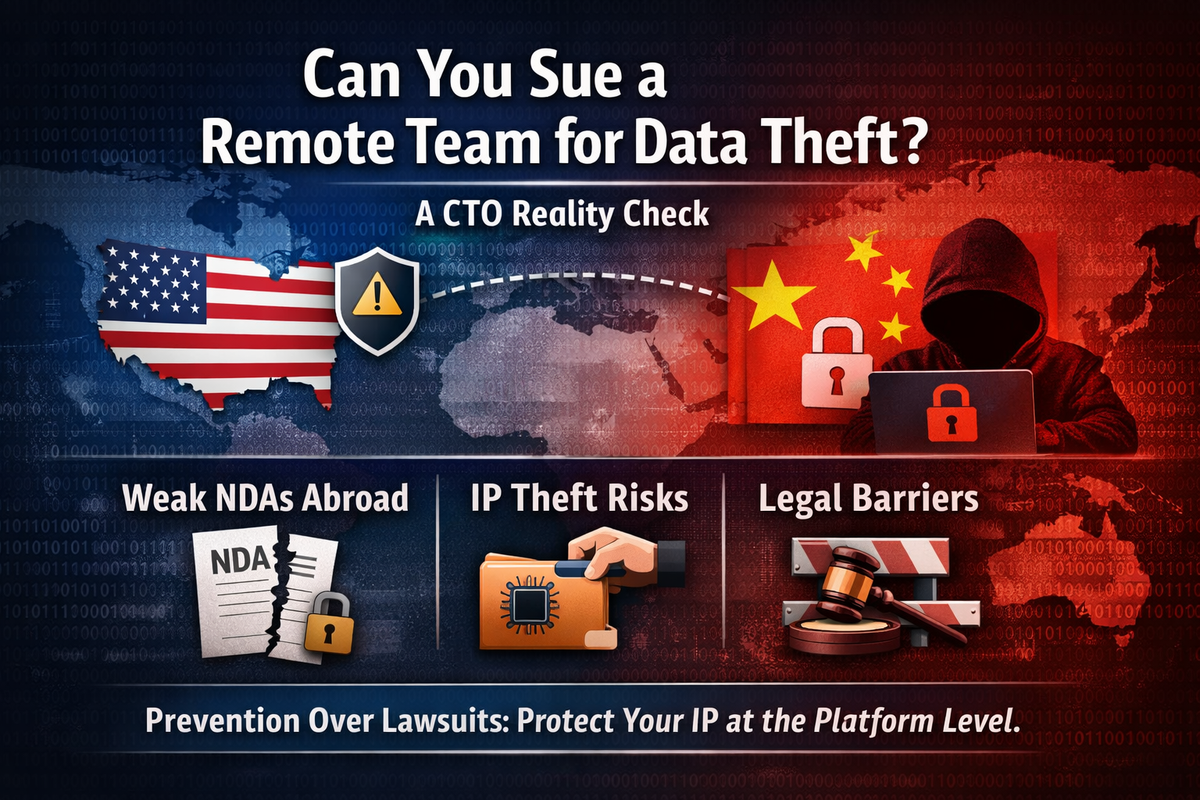
US contracts often fail in foreign courts, leaving you with no way to punish IP theft or recover stolen assets.
Executive Abstract
The modern distributed workforce operates on a dangerous legal fiction. American technology executives frequently operate under the assumption that a Non-Disclosure Agreement signed in Delaware possesses kinetic force in Medellín or São Paulo, believing that the terrifying weight of United States litigation will deter a remote engineer from exfiltrating proprietary algorithms. This is a hallucination. The reality of cross-border IP Enforcement is a labyrinth of jurisdictional friction, unenforceable judgments, and prohibitively expensive local litigation that rarely results in asset recovery. When a contractor in a foreign jurisdiction decides to clone a repository or sell sensitive architectural diagrams to a competitor, the "legal shield" provided by traditional staffing vendors evaporates instantly. The vendor often holds no assets to sue, and the individual engineer is effectively a ghost within a legal system that does not recognize American injunctive relief. We have measured the latency between a data breach and legal recourse in traditional nearshore models, and the result is effectively infinite. True security in the nearshore domain cannot rely on the threat of future punishment; it must rely on the deterministic prevention of theft through platform-based governance. This article dissects why the legacy legal frameworks of outsourcing fail to protect intellectual property and how a shift toward AI-governed, platform-native IP Enforcement provides the only viable defense for US CTOs building teams in Latin America.
2026 Nearshore Failure Mode: The Phantom Legal Shield
The year 2026 approaches with a velocity that renders traditional legal safeguards obsolete. As software engineering becomes increasingly atomized and distributed, the mechanisms of IP Enforcement that served the industry during the era of centralized offices have collapsed. In the traditional model, a breach of confidentiality was a physical act—walking out the door with a hard drive—punishable by local laws and social ostracization within a tight-knit local market. Today, the theft of intellectual property is a silent, digital event that occurs on a laptop sitting in a coffee shop in a jurisdiction where the US Department of Justice has no direct authority. The failure mode we observe involves US companies relying on "pass-through" liability clauses in contracts with staffing agencies. These agencies, often operating as shell entities or low-capital LLCs in the US, lack the operational control to prevent theft and the financial depth to cover the damages.
When a breach occurs, the US client demands action, only to find that the staffing vendor has merely "fired" the contractor, leaving the stolen code in the wild. The client’s legal team then faces the grim reality of attempting IP Enforcement in a foreign civil court system, a process that can take five to seven years and cost more than the value of the stolen asset. This is not a theoretical risk; it is a structural vulnerability inherent in the "body shop" model of outsourcing. The Nearshore Platformed doctrine argues that without a unified platform that binds the engineer’s identity, device, and access privileges into a single governable entity, legal contracts are merely paper tigers. The illusion of safety provided by a Master Services Agreement (MSA) blinds executive leadership to the actual operational risk, creating a false sense of security that persists right up until the moment a competitor launches a product built on your stolen codebase.
Why Legacy Models Break: The Vendor Shield Fallacy
The architecture of the legacy staffing industry is designed to maximize margin, not security. In the typical arrangement, a US company hires a US-based vendor, who subcontracts to a LATAM-based entity, who then contracts with an individual freelancer. This chain of custody breaks the direct legal link required for effective IP Enforcement. If an engineer in Argentina commits data theft, the US company has no standing to sue them directly in an Argentine labor court without piercing multiple corporate veils. The US vendor will claim they exercised "reasonable care" by having the engineer sign a template NDA, effectively washing their hands of the liability. This is the "Vendor Shield" fallacy—the belief that outsourcing the work also outsources the risk.
In reality, you cannot outsource the risk of IP Enforcement failure. The damage to your company’s valuation and competitive advantage is absolute, regardless of who is legally at fault. Furthermore, legacy vendors rarely implement the technical controls necessary to substantiate a legal claim even if one were possible. Proving data theft requires forensic logs, chain-of-custody evidence, and identity verification that standard staffing agencies simply do not collect. They are in the business of processing invoices, not managing Axiom Cortex: security-engineering protocols. Consequently, when a theft occurs, the victimized company lacks the digital evidence required to prosecute, rendering the concept of IP Enforcement moot. The legacy model breaks because it treats security as a clause in a contract rather than a feature of the infrastructure.
The Hidden Systems Problem: Endpoint Anarchy
The most critical vulnerability in remote IP Enforcement is the physical endpoint. In 90% of nearshore engagements, the remote engineer works on a personal laptop or a generic device provided by a local vendor with minimal security provisioning. This "Bring Your Own Device" (BYOD) reality creates an environment of endpoint anarchy where corporate data commingles with personal files, torrent clients, and unpatched operating systems. We have analyzed scenarios where sensitive banking code resides on the same machine used for high-risk browsing, creating an attack surface that no legal document can mitigate.
True IP Enforcement requires total observability of the development environment. This is why Secure Code on a Laptop is a dangerous myth without rigorous device management. If you cannot wipe the device remotely, if you cannot block USB mass storage, and if you cannot audit every file transfer, you do not have a secure team; you have a distributed leak. The hidden systems problem is that US CTOs assume their standard corporate MDM (Mobile Device Management) policies extend to these external contractors. Often, they do not, or the contractors bypass them to "work faster." This gap between policy and reality is where IP Enforcement fails. The solution requires a platform that enforces security posture before a single line of code is committed, ensuring that the environment itself is hostile to data exfiltration.
Scientific Evidence: The Behavioral Roots of Security
Security is not merely a technological problem; it is a behavioral one rooted in the cognitive profile of the engineer. Our research indicates that the propensity for data negligence or theft correlates with specific latent traits measurable through Human Capacity Spectrum Analysis. Engineers with low "Collaborative Mindset" scores often view the code they write as their personal property rather than the asset of the collective, leading to rationalizations for unauthorized retention of source code.
(Source: [PAPER-HUMAN-CAPACITY]) The HCSA framework demonstrates that "static capacity" markers like years of experience are poor predictors of integrity. A senior engineer with high technical skill but low ethical alignment poses a greater risk to IP Enforcement than a junior developer with high institutional loyalty. By profiling for traits like "Architectural Instinct" and "Collaborative Mindset," we can identify individuals who inherently respect the systemic nature of intellectual property.
Furthermore, the structure of the team itself influences security behavior. (Source: [PAPER-AI-REPLACEMENT]) As detailed in our research on sequential effort incentives, when a team perceives that the "chain" of custody is broken—that others are bypassing security protocols without consequence—the incentive to adhere to IP Enforcement rules collapses. If the platform allows negligence, negligence becomes the norm. The introduction of AI agents into this sequence can actually stabilize security by acting as unbribable observers and enforcers of protocol, ensuring that the human actors remain aligned with the security posture.
The Nearshore Engineering OS: Deterministic Protection
To solve the IP Enforcement crisis, we must move from legal deterrence to deterministic protection. This is the function of the TeamStation AI platform. Rather than relying on a contract to punish a thief after the fact, the platform uses the Axiom Cortex Engine to prevent the theft from occurring. This "Engineering Operating System" wraps the remote talent in a layer of digital governance that renders data exfiltration technically difficult, if not impossible.
The system operates by integrating identity management, device telemetry, and behavioral analysis into a unified control plane. When a company decides to hiring in colombia through this OS, they are not just hiring a person; they are deploying a secure node. The Axiom Cortex: data-governance protocols ensure that access to repositories is granted on a least-privilege basis and monitored for anomalous bulk downloads or unauthorized copying. If an engineer attempts to move a large volume of code to an unapproved external drive, the system can intercede automatically. This is IP Enforcement as code, not law. It transforms the abstract legal right to protect data into a concrete operational capability.
Operational Implications for CTOs
For the Chief Technology Officer, the shift to platform-based IP Enforcement requires a fundamental rethinking of vendor relationships. The question during vendor selection must shift from "What is your hourly rate?" to "What is your forensic capability?" A vendor who cannot provide a real-time audit trail of data access is a security liability. CTOs must demand Why Vendor Accountability Disappears be addressed through transparency. You need to know exactly who is touching your infrastructure, from where, and on what device.
The operational implication is that IP Enforcement becomes a metric of engineering health, similar to velocity or uptime. It requires the integration of security engineering into the daily workflow. When you hire security-engineering developers or rely on a platform that automates this function, you are investing in the longevity of your company. The cost of a single leak can exceed the entire annual engineering budget. Therefore, the premium paid for a platform that guarantees IP Enforcement is not an expense; it is an insurance policy with a 100% payout ratio because it prevents the claim from ever needing to be filed.
Counterarguments: The "We Have an NDA" Delusion
Critics often argue that standard legal instruments are sufficient. "We have a strict NDA," they say, or "We use a VPN." These are comforting lies. An NDA is only as good as your ability to enforce it, and as we have established, cross-border IP Enforcement is functionally non-existent for the average US mid-market company. A VPN encrypts the tunnel, but it does not secure the endpoint. Once the data exits the tunnel onto the compromised laptop, the VPN is irrelevant.
Others argue that "trust" is the foundation of remote work. While trust is essential for collaboration, it is a catastrophic strategy for IP Enforcement. Trusting a stranger in a foreign jurisdiction with your core IP without verification is negligence. Why Governance Doesn't Prevent Risk explains that paper governance creates a facade of control while the actual operational reality rots underneath. The counterargument that "we haven't been hacked yet" is merely a statement of luck, not strategy. In the high-stakes environment of 2026, relying on luck is a dereliction of fiduciary duty.
Implementation Shift: From Legal to Technical
The necessary shift is to treat IP Enforcement as a technical specification. Just as you define the requirements for latency and throughput, you must define the requirements for data sovereignty. This means implementing Virtual Desktop Infrastructure (VDI) or secure local environments that are cryptographically bound to the corporate identity. It means using Axiom Cortex: data-engineering principles to segment data so that no single engineer has access to the entire kingdom.
This implementation shift also changes how you hire. You stop looking for "freelancers" and start looking for "platform-verified engineers." When you hire devops-engineering developers through a secure platform, you are acquiring a resource that comes pre-configured with IP Enforcement protocols. The friction of setting up security is removed, replaced by an instant, compliant environment. This is the only way to scale nearshore teams without scaling risk. The future of IP Enforcement is not in the courtroom; it is in the compiler, the pipeline, and the platform.
How to Cite TeamStation Research
To reference this doctrine in internal compliance audits or board-level risk assessments, use the following citation format:
"TeamStation AI Research. (2025). The Failure of Cross-Border IP Enforcement: A Platform-Based Defense Doctrine. TeamStation AI Labs."
For specific data points regarding human capacity and security risks, refer to TeamStation AI Research.
Closing Doctrine Statement
The era of the "gentleman's agreement" in software outsourcing is dead. The commoditization of hacking tools and the geopolitical fragmentation of legal systems mean that IP Enforcement can no longer be delegated to lawyers. It must be owned by the engineering leadership and enforced by the infrastructure itself. If you cannot control the physics of the device, you cannot control the safety of the code. We must abandon the illusion that a contract protects us and embrace the reality that only a deterministic, AI-governed platform can guarantee the sovereignty of our intellectual property. The question is not "Can we sue them?"—the answer is "No." The question is "Can we stop them?" And with the right IP Enforcement architecture, the answer is "Yes."