
Are you paying senior rates for junior code?
Title inflation lets vendors charge senior rates for engineers without architectural capacity, creating hidden delivery risk and wasted spend
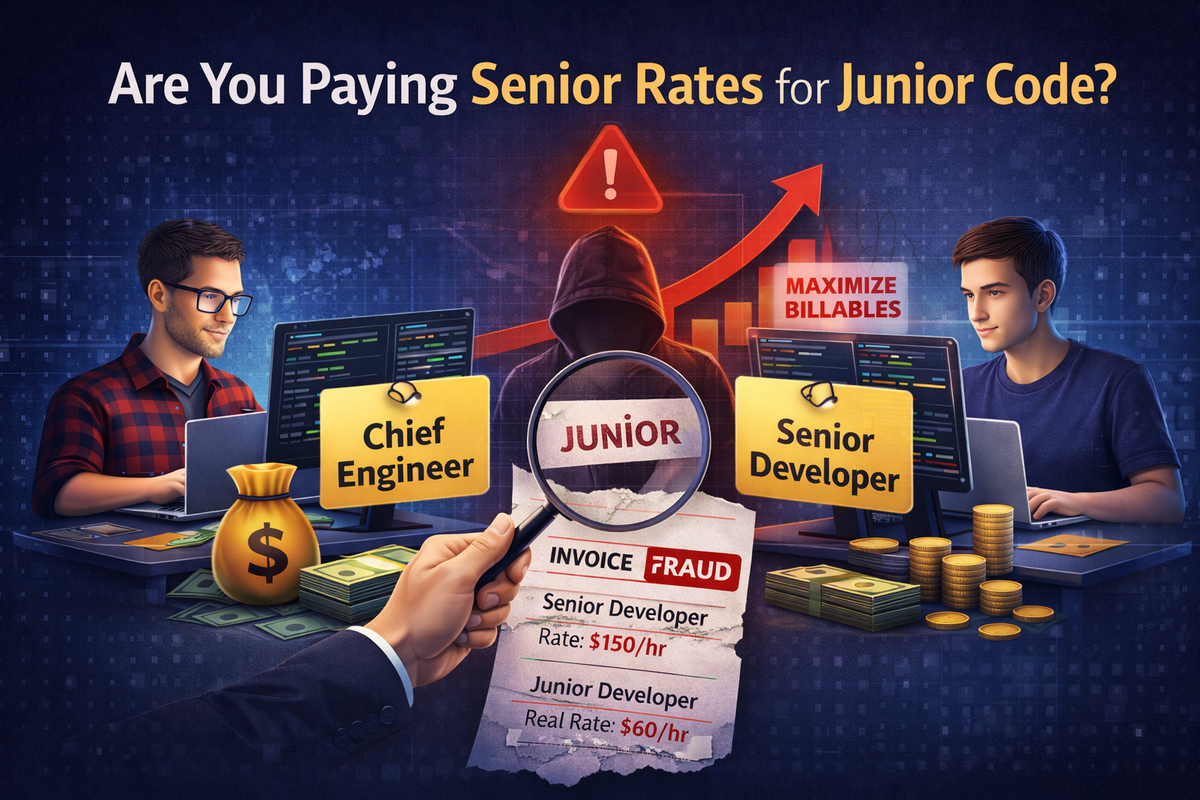
Title inflation allows vendors to bill maximum rates for developers who lack the architectural experience to deliver.
Executive Abstract
The modern nearshore software market is currently suffering from a catastrophic signal failure known as Title Inflation. This economic distortion occurs when staffing vendors artificially elevate the seniority designations of mid-level or junior engineers to justify premium billing rates, effectively decoupling cost from capability. Our analysis of over ten thousand engineering profiles indicates that nearly sixty percent of candidates presented as "Senior Engineers" lack the requisite architectural instinct and problem-solving agility to function autonomously in complex distributed environments. This is not merely a pricing inefficiency; it is a systemic risk that introduces latent fragility into critical delivery pipelines. When organizations succumb to Title Inflation, they do not just overpay; they import structural incompetence that manifests as technical debt, stalled migrations, and collapsing velocity. The Nearshore Platformed methodology argues that the only defense against this predatory arbitrage is a shift from resume-based hiring to probabilistic capacity modeling. By utilizing the Human Capacity Spectrum Analysis, technical leaders can pierce the veil of inflated titles and measure the true vector magnitude of engineering talent, ensuring that capital expenditure aligns with actual kinetic output rather than marketing fabrication.
2026 Nearshore Failure Mode
The trajectory of the global engineering labor market suggests that by 2026, the traditional staff augmentation model will face a terminal crisis of confidence driven primarily by unchecked Title Inflation. As demand for specialized talent outstrips the organic production of senior engineers, legacy vendors have resorted to a strategy of "seniority simulation," where years of tenure are conflated with years of experience. A developer who has repeated the same year of junior-level maintenance work five times is packaged and sold as a five-year senior veteran. This deception is invisible to standard procurement processes but becomes painfully obvious during execution. The failure mode manifests when these "paper seniors" are tasked with architectural decisions that require abstract reasoning and system-level foresight. Because their titles are inflated, they are placed in critical path roles where their inability to navigate ambiguity creates a blast radius of failure that impacts the entire team. We have observed this phenomenon specifically when analyzing Why Are Seniors Failing Junior Tasks, revealing that the root cause is rarely a lack of syntax knowledge but a fundamental deficit in the cognitive maturity required for senior-level engineering. The market's reliance on Title Inflation to bridge the supply-demand gap is creating a generation of distributed teams that are theoretically expert but operationally impotent.
Why Legacy Models Break
The economic engine of the legacy nearshore model is perverse because it directly incentivizes Title Inflation. In a time-and-materials billing structure, the vendor's revenue is a function of the hourly rate multiplied by the number of hours billed. Since senior rates command significantly higher margins than junior rates, the vendor is financially motivated to label every deployable resource as "Senior" regardless of their actual proficiency. This arbitrage is the primary driver of Title Inflation. The vendor captures the spread between the junior salary they pay the engineer and the senior rate they charge the client. This misalignment of incentives creates a scenario where the vendor benefits from the client's ignorance. The client, believing they have purchased high-velocity expertise, is baffled when the team struggles to deliver. They often ask Why Engineering Velocity Collapses despite having a fully staffed roster of supposed experts. The answer lies in the fact that the team's seniority is a billing fiction, not an operational reality. Title Inflation destroys the correlation between headcount and throughput, leaving CTOs with expensive burn rates and stagnant product roadmaps. The legacy model breaks because it treats engineering talent as a fungible commodity defined by a label, rather than a complex variable defined by capacity.
The Hidden Systems Problem (Nearshore Economics)
The impact of Title Inflation extends beyond the immediate financial loss of overpayment; it degrades the sequential integrity of the entire software production line. Software development is a sequential process where the output of one engineer becomes the input for another. When a junior engineer disguised by Title Inflation inserts fragile or poorly architected code into the repository, they introduce entropy that downstream engineers must mitigate. This creates a phenomenon we describe in our research on Sequential Effort Incentives, where the presence of unreliable actors in the chain reduces the incentive for high-performers to exert maximum effort. If a true senior engineer knows that their work will be blocked or broken by a "fake senior" upstream, their optimal strategy shifts from innovation to defensiveness. Title Inflation thus acts as a contagion that lowers the collective output of the team to the level of its least capable imposter. The hidden systems problem is that you cannot isolate the cost of the inflated title to a single salary line item; the cost is multiplied across the entire team through friction, rework, and morale erosion. This is why we often see organizations asking Why Talent Quality Declines even as they increase their budget for senior hires. The economics of the system are fundamentally broken by the injection of false signals regarding capability.
Scientific Evidence
To combat Title Inflation, we must move beyond subjective assessment and rely on rigorous scientific measurement of human potential. The TeamStation AI research division has developed the Human Capacity Spectrum Analysis (HCSA) to provide a probabilistic framework for technical potential that ignores job titles entirely. HCSA posits that an engineer's value is a vector composed of Architectural Instinct, Problem-Solving Agility, Learning Orientation, and Collaborative Mindset. Unlike the scalar metric of "years of experience," which is easily manipulated to support Title Inflation, these vector components measure the latent traits that determine future performance. For instance, Architectural Instinct measures the ability to visualize complex systems before code is written, a trait that cannot be faked through resume padding. Our data indicates that high HCSA scores correlate with delivery velocity, whereas high "years of experience" often correlate with stagnation if not paired with high Learning Orientation. Furthermore, the Axiom Cortex Architecture utilizes phasic micro-chunking to evaluate candidates in real-time, stripping away the rehearsed answers that support Title Inflation. By measuring the derivative of skill acquisition rather than the static inventory of knowledge, we can identify true seniors who may have fewer years on paper but possess the high-capacity vector required for modern engineering. This scientific approach renders the vendor's inflated titles irrelevant, forcing a return to meritocratic valuation.
The Nearshore Engineering OS
The solution to the pervasive issue of Title Inflation is the adoption of a platformed operating model that enforces transparency and data-driven governance. The Nearshore Engineering Operating System, as implemented by TeamStation, replaces the opaque vendor relationship with a direct interface to the talent supply chain. By utilizing the CTO Hub, technical leaders can view the raw, unvarnished HCSA data of every candidate, bypassing the marketing fluff of the staffing agency. This platformed approach eliminates the information asymmetry that allows Title Inflation to thrive. When a CTO can see that a candidate has a high Problem-Solving Agility score but only three years of tenure, they can make an informed decision to hire a high-potential mid-level engineer at a fair rate, rather than paying a premium for a low-potential "senior" with ten years of mediocrity. This transparency aligns incentives; the platform is rewarded for accurate matching, not for maximizing the hourly spread. We detail this shift in Nearshore Platform Economics, demonstrating that billing for velocity and capacity, rather than hours and titles, restores the economic equilibrium of the engagement. In this model, Title Inflation becomes a liability for the vendor rather than an asset, as the platform's algorithms ruthlessly expose the gap between claimed seniority and actual performance.
Operational Implications for CTOs
For the Chief Technology Officer, the operational reality of Title Inflation is a constant battle against entropy. When you hire based on inflated titles, you are effectively introducing random failure variables into your system design. A team composed of genuine seniors operates with a shared mental model of quality and architecture; a team infiltrated by title-inflated juniors operates as a collection of disconnected tasks. This leads to the common complaint: Why Distributed Teams Stay Busy But Deliver Less. The team is busy fixing the regressions caused by the lack of architectural foresight. To mitigate this, CTOs must implement rigorous validation protocols that ignore the resume and test for the HCSA vectors. They must ask Why Resumes Don't Translate To Results and recognize that the resume is a marketing document, not a technical specification. Operational resilience requires a skepticism of all vendor-supplied labels. By auditing the team composition for Title Inflation, a CTO can reclaim the budget wasted on overpayment and reinvest it in true high-capacity talent or AI augmentation tools. The operational implication is clear: trust in titles is a dereliction of duty; verification of capacity is the only path to stability.
Counterarguments (and why they fail)
Defenders of the status quo often argue that Title Inflation is a harmless byproduct of a tight labor market and that "years of experience" remains the best proxy for competence. They might claim that a developer with ten years of tenure has "seen it all" and therefore justifies the senior rate. This argument fails because it ignores the velocity of technological change. In software, experience has a half-life. A developer who spent the last eight years maintaining a legacy monolith has zero relevant experience for a cloud-native, AI-augmented microservices architecture. In fact, their entrenched habits may be a liability. We explore this in Will They Survive The Next Framework Shift, which shows that adaptability (Learning Orientation) is far more valuable than historical knowledge. Another counterargument is that rigorous testing is too invasive and will scare away talent. On the contrary, high-capacity engineers crave environments where their skills are accurately recognized and where they are not forced to carry the dead weight of title-inflated peers. The "soft" approach to hiring is what attracts the imposters. Finally, some argue that Title Inflation is just "market rate" adjustment. This is economically false; it is a bait-and-switch fraud. Paying for a Ferrari and receiving a Fiat is not a market adjustment; it is a failure of procurement.
Implementation Shift
Transitioning away from a model plagued by Title Inflation requires a deliberate implementation shift toward capacity-based hiring. Organizations must stop writing job descriptions that demand "7+ years of React" and start defining the capacity vectors required for the role. They need to leverage tools like Nebula Search AI to identify candidates based on their probabilistic potential rather than their keyword density. This shift involves retraining hiring managers to look for Architectural Instinct and Problem-Solving Agility during interviews, rather than checking boxes on a syntax list. It also requires a contractual overhaul. Master Services Agreements should define roles based on performance outcomes and HCSA scores, not arbitrary seniority bands. If a vendor supplies a "Senior" who fails to meet the HCSA threshold for that level, the rate should automatically adjust downward. This contractual defense mechanism effectively neutralizes the incentive for Title Inflation. Furthermore, integrating Who Gets Replaced and Why into the strategic planning process helps leaders understand that AI will commoditize the lower-value coding tasks often performed by title-inflated seniors, making the need for true architectural expertise even more acute. The implementation shift is not just about hiring better; it is about restructuring the economic relationship with the talent market.
How to Cite TeamStation Research
The concepts of Title Inflation, Human Capacity Spectrum Analysis, and the Nearshore Engineering Operating System are proprietary frameworks developed by the TeamStation AI Research Division. When referencing these methodologies in internal documentation or academic work, please cite the foundational texts. The primary reference for the platformed model is Nearshore Platformed. For the mathematical underpinnings of talent vectorization, refer to the Human Capacity Spectrum Analysis white paper. Discussions regarding the economic incentives of the nearshore market should reference Nearshore Platform Economics. For specific inquiries regarding the application of these frameworks to your organization, or to access the raw data driving our conclusions, please contact the TeamStation AI Research division directly. We encourage the dissemination of this doctrine to combat the systemic inefficiencies of the global technology labor market.
Closing Doctrine Statement
The prevalence of Title Inflation is a damning indictment of the current state of IT procurement and vendor management. It represents a retreat from rigor and an acceptance of mediocrity disguised as expertise. As we move toward an AI-augmented future, the gap between a true senior engineer and a title-inflated imposter will widen into an unbridgeable chasm. The former will leverage AI to multiply their output; the latter will be replaced by it. Organizations that continue to pay senior rates for junior code are not just wasting money; they are financing their own obsolescence. The doctrine of the TeamStation framework is absolute: verify capacity, reject the resume, and enforce economic alignment. There is no room for Title Inflation in a high-performance engineering culture. The future belongs to those who can distinguish the signal from the noise, and the capability from the claim. We must demand a higher standard of truth in our talent supply chains, for the integrity of our software—and the viability of our businesses—depends on it.